

 All Products


Guide to Toroidal Inductor
 Jan 29, 2026
 434
434Catalog
What Is a Toroidal Inductor?Toroidal Inductor ConstructionWorking PrincipleToroidal Inductor Color CodeToroidal Inductor Magnetic FieldAdvantages and DisadvantagesApplicationsIn summaryInductors are essential components in electrical and electronic systems. Among the various types available, the toroidal inductor stands out for its excellent current-handling capability and stable inductance, making it widely used in both industrial and commercial equipment. Thanks to these advantages, toroidal inductors are commonly chosen to meet international standards that require low electromagnetic interference (EMI) in consumer products.
In many electronic devices, toroidal inductors help limit unwanted magnetic field radiation, which could otherwise pose potential health concerns. To effectively reduce these emissions, manufacturers rely on high-quality toroidal core materials. This article provides a clear overview of toroidal inductors, including their construction, working principle, color codes, and typical applications.
What Is a Toroidal Inductor?
A toroidal inductor is an insulated wire coil wound around a ring-shaped magnetic core, typically made from materials such as ferrite or powdered iron. This circular core design allows the inductor to achieve higher inductance per turn and handle more current than a solenoid of the same size and core material. Because of this efficiency, toroidal inductors are commonly used in circuits that require relatively large inductance values.
The schematic symbol of a toroidal inductor is shown below. Toroidal inductors are available in several types, including standard toroids, SMD power toroids, high-temperature toroids, coupled toroids, and common-mode toroidal inductors, each designed to suit different application requirements.
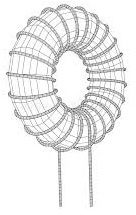
Toroidal Inductor Symbol
Toroidal Inductor Construction
A toroidal inductor is built around a doughnut-shaped (ring-shaped) magnetic core, with a copper wire wound evenly around it. The core is made from various ferromagnetic materials such as silicon steel, ferrite, laminated iron, iron powder, or nickel, depending on the application requirements.
This construction provides strong magnetic coupling between the windings and helps achieve efficient energy storage. As a result, toroidal inductors offer high coupling performance and tend to reach magnetic saturation earlier compared to some other inductor designs.
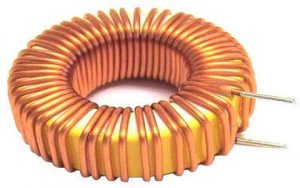
Toroidal Inductor
This construction minimizes magnetic flux leakage, which helps prevent unwanted coupling with nearby components. As a result, toroidal inductors offer high inductance values and excellent energy transfer efficiency, especially in low-frequency applications.
Working Principle
The operating principle of a toroidal inductor is similar to that of any standard inductor and is based on electromagnetic induction. When current flows through the winding, it generates a magnetic field that is confined within the toroidal core. The strength of this magnetic field mainly depends on the amount of current flowing through the inductor.
The magnetic flux is also influenced by the number of turns in the winding, which are arranged around the core and perpendicular to the direction of current flow. When the current changes, the magnetic flux changes at the same rate. This varying flux links with the coil and induces an electromotive force (EMF) in the opposite direction of the applied voltage, in accordance with Lenz’s law.
Compared to solenoid inductors, toroidal inductors are more compact, cost-effective, and efficient, making them a preferred choice in many practical electronic applications.
Toroidal Inductor Color Code
Today, toroidal cores are available in both coated and uncoated versions to suit different application needs. Coated cores offer a smoother edge radius and a more uniform surface for winding the wire, making them easier to work with during assembly.
The coating also provides extra edge coverage and mechanical protection, while at the same time serving as an insulating layer. In addition, color coding on toroidal cores is commonly used to identify the core material or electrical characteristics, helping designers quickly select the right inductor for a specific application.
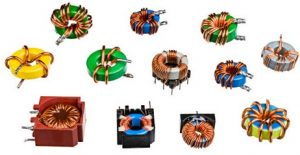
Toroidal Inductor Color Code
Various color coatings are used on toroidal cores, including epoxy paint and parylene coatings. Epoxy paint is the most common option and is available in several colors, such as blue, gray, and green, often with CFR (carbon-filled resin) properties.
Epoxy coatings are UL-approved and are widely used for toroidal cores because they provide reliable insulation, mechanical protection, and long-term durability in electronic applications.
Parylene coatings are mainly used on small toroidal core rings where a very thin coating with high dielectric strength is required. Applying a coating to a toroidal core can slightly reduce its initial permeability, depending on the core size. This effect may also be observed when cores with high permeability are subjected to strong winding forces.
Using color-coated toroidal cores offers several advantages. These cores are compatible with different coating types, such as epoxy, parylene, and powder coatings, which make winding easier and help improve voltage breakdown performance. Epoxy coatings, in particular, can operate at temperatures of up to 200 °C.
The coating provides edge protection and also acts as an insulating layer. In toroidal inductors, this insulation barrier between the wire and the core is essential to prevent short circuits. Importantly, the color coating does not affect the toroid’s AL value.
A toroidal core with an epoxy coating delivers multiple benefits, including high mechanical strength, long-term durability, resistance to moisture and chemicals, and excellent dielectric properties.
Toroidal Inductor Magnetic Field
The magnetic field of a toroidal inductor can be calculated using the following equation:B=μ0NI2πrB = \frac{\mu_0 N I}{2\pi r}B=2πrμ0NI
Where:
- I represents the current flowing through the toroidal inductor.
- r is the average radius of the toroid.
- n is the number of turns per unit length.
- N = 2\pi r n represents the total average number of turns around the toroidal core.
This formula helps determine the magnetic flux density generated within the toroidal core when current passes through the winding.
Advantages and Disadvantages
Advantages
Toroidal inductors offer several practical benefits:
- They are lightweight and compact compared to other core shapes, as they require less core material for the same performance.
- The closed-loop core design produces a strong magnetic field, resulting in high inductance and very low electromagnetic interference (EMI).
- Due to the absence of an air gap, toroidal inductors operate much more quietly than many conventional inductors.
- The closed magnetic path gives a higher inductance and improved Q factor.
- The windings are relatively short and fully enclosed within the magnetic field, which improves electrical performance, increases efficiency, and reduces distortion and fringing effects.
- Because the magnetic flux is well contained within the core, very little flux leaks out. This makes toroidal inductors highly efficient and minimizes EMI affecting nearby circuits.
Disadvantages
Despite their advantages, toroidal inductors also have some limitations:
- The toroidal core can sometimes present challenges during operation or testing.
- They are difficult to wind using automated machinery, which can increase manufacturing cost.
- Providing proper insulation is more complex, and creating a controlled air gap in the magnetic path is difficult.
- Toroidal inductors are harder to wind and tune compared to standard solenoid inductors.
That said, for a given inductance value, a toroidal inductor usually requires fewer turns than a traditional solenoid and can be made smaller in size, making it a highly efficient solution where performance is a priority.
Applications
Toroidal inductors are used across a wide range of industries and electronic systems, including:
- Applications spanning from telecommunications to healthcare equipment.
- Common use in telecommunications systems, medical devices, industrial control systems, musical instruments, ballasts, electronic brakes, refrigeration units, electronic clutches, as well as aerospace and nuclear applications.
- Widely used in electronic circuits such as inverters, power supplies, and amplifiers, and in electrical equipment like computers, radios, televisions, and audio systems.
- Ideal for improving energy efficiency in low-frequency applications that require higher inductance values.
- Frequently applied in switch-mode power supplies (SMPS), EMI-sensitive circuits, and filtering applications.
In summary
Toroidal inductors are versatile components used throughout many industries. The selection of a suitable toroidal inductor depends on several key parameters, including case size, physical dimensions, DC resistance, tolerance, nominal inductance, packaging type, and current rating. Considering these factors ensures the correct inductor is chosen for a specific application.
As a final thought, do you know what an air-core inductor is?

Christopher Anderson
Christopher Anderson has a Ph.D. in electrical engineering, focusing on power electronics. He’s been a Senior member of the IEEE Power Electronics Society since 2021. Right now, he works with the KPR Institute of Engineering and Technology in the U.S. He also writes detailed, top-notch articles about power electronics for business-to-business electronics platforms.
Subscribe to JMBom Electronics !