

 All Products


Introduction to Loop Antenna
 Dec 12, 2025
 526
526Catalog
What is a Loop Antenna?Loop Antenna Design & OperationTypes of Loop AntennasAdvantages of Loop AntennasDisadvantages of Loop AntennasApplications/Uses of Loop AntennasIn SummaryRelated ArticlesAn antenna is a metal structure or aerial that transforms electrical currents into electromagnetic (EM) waves. These antennas are primarily used to transmit and receive non-ionizing electromagnetic fields, including microwaves, radio waves, infrared radiation, and visible light. Antennas come in various types, sizes, and shapes. Small antennas are commonly found on rooftops for TV reception, while larger ones are used to capture satellite signals. A loop antenna, particularly in radio communication, is highly regarded for its distinct characteristics and wide range of applications. Understanding the fundamentals and advantages of loop antennas can help us appreciate their importance in modern communication systems. This article offers a concise overview of loop antennas, including their types, operation, and applications.
What is a Loop Antenna?
A loop antenna is a type of radio antenna made by coiling a wire into a loop. This loop carries a radio frequency current. The shape, size, and orientation of the loop can vary, and these factors affect the antenna’s performance. The symbol for a loop antenna is shown below.
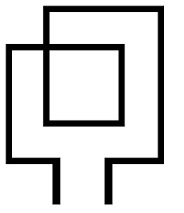
The efficiency of a loop antenna is primarily influenced by its size and the operating frequency. Smaller loop antennas are especially sensitive to the magnetic component of the electromagnetic field, which is why they’re often referred to as magnetic loop antennas. This characteristic makes them less susceptible to interference and electrical noise, making them highly beneficial for applications such as amateur radio communications and shortwave radio reception.
Loop Antenna Design & Operation
A loop antenna is designed with a coil that carries a radio frequency current. The shape of the loop can vary, and it can be bent into different forms such as rectangular, circular, square, hexagonal, or triangular, depending on the designer's preference. The current flowing through the antenna remains in phase, and the magnetic field is perpendicular to the entire loop that carries the current.
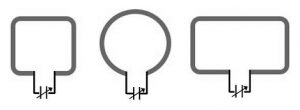
These antennas operate based on the principle of electromagnetic induction. When RF energy is present, it generates an alternating magnetic field, which induces a current within the loop. This allows the antenna to transmit or receive signals. The current flowing through the loop creates an electric field, which radiates energy as an electromagnetic wave, enabling radio communication. The frequency range for loop antennas typically spans from 300 MHz to 3 GHz. The performance of these antennas can be improved by adjusting factors such as the shape and the materials used in constructing the loop.
Loop antennas share characteristics with monopoles and dipoles in that they are cost-effective and easy to build. They come in various shapes, but the fundamental radiation pattern characteristics are generally independent of the loop's shape. Similar to monopoles and dipoles, the electrical length of the antenna impacts its efficiency. The electrical size of the loop determines its overall performance.
Types of Loop Antennas
Loop antennas come in various types, depending on factors like the size of the loop, configuration, and orientation. These different types are discussed below.
Small Loop Antennas
Small loop antennas, also known as magnetic loop antennas, are characterized by their compact size. These antennas are typically sensitive to the magnetic component of the electromagnetic field, making them ideal for applications where space is limited but effective signal reception or transmission is still needed.
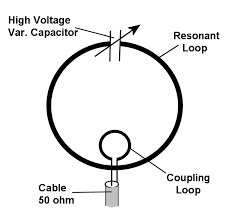
Small Loop Antenna
Small loop antennas have a circumference that is less than 1/10th of the wavelength of the operating frequency. Due to their compact size, they are commonly used in portable applications or installations where space is limited. Despite their small size, these antennas can deliver good performance, including decent gain and radiation efficiency, especially when tuned with a capacitor.
While they are primarily used as receiving antennas, small loop antennas are occasionally used for transmission, although they have lower efficiency and smaller loop sizes compared to larger antennas. A common example of a small loop antenna is the ferrite or loop stick antenna, typically found in AM broadcast radios. The radiation pattern of these antennas is strongest in the plane of the loop, making it perpendicular to the radiation pattern of larger loop antennas.
Large Loop Antennas
Large loop antennas, also known as full-wave loops or self-resonant loop antennas, have a circumference greater than 1/10th of the wavelength of the operating frequency. These antennas are much more efficient than smaller types in terms of both transmission and reception. They also offer higher gain compared to small loop antennas, making them more effective for various applications.
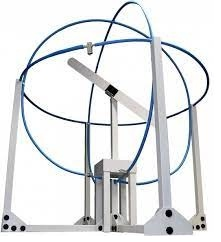
Large Loop Antenna
These antennas are ideal for various applications, including radio direction finding, radio astronomy, and long-distance communication. The radiation pattern of a large loop antenna typically features a two-lobe pattern, with peaks in both directions. The full-wave resonances are perpendicular to the plane of the loop.
Multi-turn Loop Antennas
Multi-turn loop antennas consist of multiple turns of wire or other conducting material, which expands the effective region of the loop. These antennas offer improved gain and higher radiation resistance compared to single-turn loops. They are commonly used in applications such as radio direction finding, low-frequency communication, and magnetic field sensing.
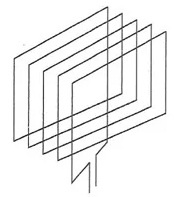
Multi-Turn Type
Horizontal Loop Antennas
A loop antenna that is oriented horizontally is known as a horizontal loop antenna. These antennas are often referred to as skywave antennas because they are commonly used for long-range communication. Their design allows them to capture signals reflected from the ionosphere, making them ideal for distant transmissions.
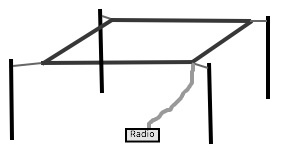
Horizontal Loop Type
Vertical Loop Antennas
A loop antenna oriented vertically is called a vertical loop antenna. These antennas are particularly effective at capturing ground wave signals. They are commonly used in applications such as direction finding and short-range communication.
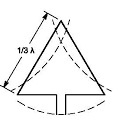
Vertical Type
Radiation Pattern
The radiation pattern of a loop antenna is similar to that of a short horizontal dipole antenna. In the diagram below, radiation patterns are shown for various loop angles. The tangent lines at 0° indicate vertical polarization, while the line at 90° shows horizontal polarization.
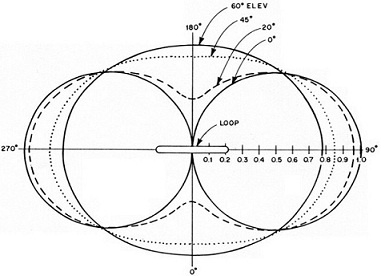
Radiation Pattern of Loop Antenna
The polarization of a loop antenna can be either horizontal or vertical, depending on the position of the feed. Horizontal polarization occurs along the middle of the horizontal side, while vertical polarization occurs along the middle of the vertical side, based on the antenna's shape. Typically, a small loop antenna is linearly polarized. When placed above a movable receiver, with the output connected directly to a meter, it effectively becomes a large direction finder.
Advantages of Loop Antennas
- Loop antennas are compact, simple to design, and highly portable, offering flexibility in placement.
- They are low-cost and resistant to detuning from hand movements.
- They can operate near other antennas without causing interference.
- These antennas are lightweight and suitable for portable applications, such as direction finding.
- Various types of loop antennas are available, including the Adcock antenna, cloverleaf antenna, Alford loop, and Bellini-Tosi antenna.
- Small loop antennas, with their low electric-field noise, perform well in high-interference environments, making them ideal for radio communication.
- They exhibit directional radiation patterns, which can be advantageous in certain situations.
- Small loops in these antennas act as magnetic dipoles.
- The antenna’s radiation pattern is independent of its shape.
- Current flows in-phase and with equal magnitude throughout the loop.
Disadvantages of Loop Antennas
- The transmission efficiency of the antenna’s loop is generally low.
- They are not suitable for high-frequency applications.
- The antenna’s radiation pattern has two nulls, leading to 180-degree bearing ambiguity.
- Loop antennas tend to have poor gain, are difficult to tune, and have a narrow bandwidth.
- They are less portable compared to other antenna types.
- As direction finders, loop antennas cannot distinguish between a distant transmitter bearing and its mutual bearing.
- The efficiency of small-loop antennas is poor, limiting them to lower frequencies and making them better suited for receiving applications.
- Small-loop antennas have low radiation resistance, causing significant power loss in the form of heat due to high current flow.
Applications/Uses of Loop Antennas
Loop antennas are used in a wide range of applications, including:
- Wireless communication systems such as wireless sensor networks (WSNs), wireless power transfer (WPT) systems, and RFID systems.
- Broadcast receiver systems, where they serve as built-in antennas for AM radio.
- Direction-finding equipment in aircraft receivers and low-frequency RFID systems, especially for large loop antennas.
- HF, MF, and shortwave receivers for capturing a variety of frequencies.
- UHF transmitters for specific transmission needs.
- High-frequency wave reception in radio receivers.
- Broadcast signal reception in the longwave and mediumwave bands.
- Popular use within the amateur radio community for high-frequency band applications.
- Increasingly used in short-range wireless devices and RFID systems, especially with the rise of wireless communication and the Internet of Things (IoT).
In Summary
Loop antennas are versatile communication devices known for their directional properties, resistance to electrical interference, and compact design. Operating based on electromagnetic induction, they are commonly used in modern communication systems, radio detection, short-wave radio reception, and more.
As for your question, a dipole antenna is a type of antenna that consists of two equal-length conductors arranged in a straight line, typically fed at the center. It's widely used in a variety of communication applications due to its simplicity and effectiveness in transmitting and receiving signals.
Related Articles
Diode Dynamics: Real-World Behavior in Fast Power and RF Circuits

Christopher Anderson
Christopher Anderson has a Ph.D. in electrical engineering, focusing on power electronics. He’s been a Senior member of the IEEE Power Electronics Society since 2021. Right now, he works with the KPR Institute of Engineering and Technology in the U.S. He also writes detailed, top-notch articles about power electronics for business-to-business electronics platforms.
Subscribe to JMBom Electronics !