

 All Products


Introduction to 13009D Transistor
 Dec 04, 2025
 786
786Catalog
What Is a 13009D Transistor?13009D Transistor SpecificationsTypes13009D Transistor ApplicationsHigh-Frequency Switching Circuits13009D Transistor Equivalent13009D Transistor Pin ConfigurationWrapping UpRelated ArticlesThe 13009D is an NPN bipolar junction transistor (BJT) widely used in power electronics for its durability and high efficiency. Housed in a TO-220 package, it delivers stable performance in circuits that handle high voltages and heavy current loads. If you’d like to dive deeper into how this transistor works and where it’s used, keep reading to explore all the essential details.
What Is a 13009D Transistor?
The 13009D is a high-voltage NPN bipolar junction transistor (BJT) designed for power applications. Built with a durable structure and capable of handling high voltages and heavy currents, it is commonly used in power supplies, voltage regulation circuits, motor control systems, and high-frequency switching designs. It normally comes in a TO-220 package, which allows easy mounting to a heat sink for effective heat dissipation. Thanks to its strong electrical capacity, it can be integrated into a wide range of power-driven electronic projects.
Because of its rugged build and high power dissipation rating, the 13009D delivers stable, reliable performance even under demanding conditions. When a positive voltage is applied to the base, it allows current to flow from the collector to the emitter, making it ideal for both switching and amplification tasks in power circuits. Its ability to handle large power loads makes it a valuable component in fields such as automotive electronics, industrial systems, and renewable energy equipment.
13009D Transistor Specifications
The 13009D is a high-voltage NPN bipolar junction transistor (BJT) designed specifically for power applications. Below are its key specifications presented in a more reader-friendly way:
Types
• NPN transistor (Negative-Positive-Negative)
Package Type:
• Usually supplied in a TO-220 package, known for its durability and effective heat dissipation.
• This package type allows easy mounting to a heatsink, making it reliable for high-power applications.
Voltage Ratings:
• Collector–Base Voltage (VCBO): 700–900 V maximum with the emitter open.
• Collector–Emitter Voltage (VCEO): Typically 400–700 V maximum with the base open.
• Emitter–Base Voltage (VEBO): Usually rated between 7–9 V with the collector open.
Current Ratings:
• Collector Current (IC): Supports high current levels, typically up to several amps, suitable for power circuits.
• Base Current (IB): Usually rated up to a few hundred milliamps, as the base current controls the collector current.
Power Dissipation:
• Generally capable of dissipating several watts of heat before reaching its maximum temperature limits, reflecting strong thermal performance.
Frequency Response:
• While not tailored for high-frequency applications, it performs well in power switching circuits.
Operating Temperature Range:
• Typically operates between –55°C and +150°C, offering stable and reliable performance across a wide range of environmental conditions.
13009D Transistor Applications
Thanks to its ability to handle high voltages and heavy currents, the 13009D transistor is widely used across many power-electronics designs. Below are some common applications:
Power Supply Circuits
The 13009D helps regulate and control electrical power in both linear and switching power supplies. It plays a key role in converting AC voltage into stable DC voltage used by electronic devices.
Voltage Regulators
In voltage regulation circuits, it maintains a steady output voltage even when the input voltage or load changes. This makes it suitable for powering sensitive components like microcontrollers and integrated circuits.
Motor Control Systems
The 13009D is used to control the speed and direction of DC motors by rapidly switching the motor current on and off. It is commonly found in robotics, automation equipment, and industrial machinery where precise motor control is required.
High-Frequency Switching Circuits
Its high voltage and current ratings make it suitable for high-frequency switching applications. It is often used in switch-mode power supplies (SMPS), inverters, and high-frequency converters where efficient switching of large currents is essential.
Voltage Amplifiers
In certain power circuits, the 13009D can also function as a voltage amplifier. It boosts small input signals to drive high-power loads or transmit signals over longer distances with reduced loss.
Audio Amplifiers
The transistor can drive speakers or headphones in audio amplifier designs. It supports high power levels while maintaining clarity and good audio fidelity.
Voltage Boosters
The 13009D can be used in booster circuits to increase the output voltage from a lower input voltage, enabling proper operation of components that require a higher supply voltage.
Power Management Systems
This transistor is widely used in power management solutions where efficient power regulation, control, and distribution are needed. Typical applications include UPS units, battery chargers, and renewable energy systems.
13009D Transistor Equivalent
Finding a direct, one-to-one replacement for the 13009D can be difficult because different manufacturers may offer variations in specifications. However, several NPN power transistors can serve as suitable substitutes depending on your circuit’s voltage, current, and package requirements. Below are some commonly recommended alternatives:
MJE13009
The MJE13009 is one of the closest and most widely suggested equivalents to the 13009D. It is also an NPN BJT designed for high-voltage, high-current power applications. Like the 13009D, it typically comes in a TO-220 package, making it easy to drop into existing circuit layouts. It offers similar voltage, current, and power dissipation ratings, making it ideal for use in power supplies, voltage regulators, motor drivers, and high-frequency switching systems.
BUV48A
The BUV48A is another suitable high-voltage, high-current NPN transistor. Its electrical characteristics are comparable to the 13009D, making it a strong alternative for power electronics designs. With a robust structure and excellent heat-dissipation performance, the BUV48A is often used in power supplies, motor control circuits, voltage regulation, and other high-power applications.
TIP3055
Although the TIP3055 does not match the 13009D’s voltage and current ratings exactly, it can be used as a substitute in certain lower-voltage power circuits. It is popular in audio amplifiers and power-switching applications. Its strong power-dissipation capability makes it useful in designs that require efficient power handling but do not demand extremely high voltages.
2SC5200
The 2SC5200 is a high-power NPN transistor commonly used in audio amplifiers and general power circuits. While not a direct equivalent, its voltage and current specifications are close to those of the 13009D. It comes in a TO-264 package, which may be compatible with some layouts. It is suitable for use in power supplies, voltage regulators, audio amplifiers, and other circuits requiring high power handling.
MJL1302A
The MJL1302A is a high-power NPN transistor often used in amplifiers and switching applications. Though not a drop-in replacement, its voltage and current ratings are similar, and its TO-264 package works in many high-power designs. Its strong thermal and power-dissipation performance makes it useful in power-management circuits where a 13009D substitute is needed.
13009D Transistor Pin Configuration
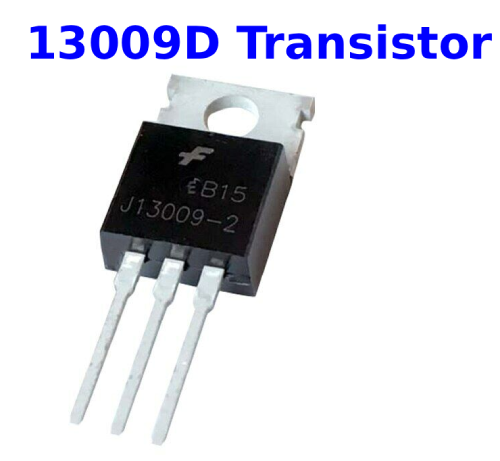
The 13009D transistor has three terminals—Collector, Base, and Emitter—each arranged in a specific order depending on its TO-220 package. Below is a clear explanation of each pin:
Collector (C)
• The collector is one of the transistor’s three main terminals and is marked with the letter C.
• In a TO-220 package, when looking at the flat front side with the pins facing downward, the collector is usually the middle pin.
• The collector is the terminal through which current flows when the transistor is operating in its active region.
Base (B)
• The base terminal is marked with the letter B.
• When viewing the transistor from the flat front side (pins pointing downward), the base is typically the leftmost pin.
• The base controls the transistor’s operation by regulating the flow of current between the emitter and collector. A small input voltage or current at the base allows a much larger current to pass from collector to emitter.
Emitter (E)
• The emitter terminal is labeled with the letter E.
• In the TO-220 package, with the pins facing downward, the emitter is usually the rightmost pin.
• In an NPN transistor, the emitter sends majority charge carriers (electrons) into the base region when forward biased. These electrons are essential for the transistor’s operation.
Wrapping Up
The 13009D transistor is a reliable and versatile component widely used across power-electronics applications. Thanks to its ability to handle high voltages and heavy currents, it performs exceptionally well in power supplies, voltage regulators, motor control systems, and high-frequency switching circuits. Its TO-220 package makes it easy to work with, offering strong heat dissipation and dependable performance, which is why both engineers and hobbyists often choose it for power-management designs. Overall, the 13009D continues to play an important role in modern electronic systems, delivering consistent power and efficiency across a wide range of applications.
Related Articles

Christopher Anderson
Christopher Anderson has a Ph.D. in electrical engineering, focusing on power electronics. He’s been a Senior member of the IEEE Power Electronics Society since 2021. Right now, he works with the KPR Institute of Engineering and Technology in the U.S. He also writes detailed, top-notch articles about power electronics for business-to-business electronics platforms.
Subscribe to JMBom Electronics !