

 All Products


Guide to Ryzen AI Max+ 395
 Jan 20, 2026
 599
599Catalog
What is the Ryzen AI Max+ 395 Processor?Ryzen AI Max+ 395 SpecificationsHow Does the AMD Ryzen AI Max+ 395 Work?Architecture ComponentsAdvantagesDisadvantagesApplicationsWhat is XDNA 2 NPU?Related ArticlesThe AMD Ryzen AI Max series processors are high-performance APUs designed for AI applications. They combine CPU, GPU, and NPU cores into a single SoC, offering a unified solution. Based on the Zen 5 architecture, these chips feature RDNA 3.5 graphics and a dedicated XDNA 2 NPU, providing outstanding AI acceleration for gaming, content creation, and professional tasks in thin laptops and mini PCs.
Ryzen AI Max processors deliver impressive performance, versatility, and efficiency, enabling the execution of complex AI models, among other benefits. Models in the series include the AMD Ryzen AI Max 385, 390, and Max+ 395. This article dives into the Ryzen AI Max+ 395 processor, its functionality, and its applications.
What is the Ryzen AI Max+ 395 Processor?
The Ryzen AI Max+ 395 is a high-performance processor from AMD, designed for gaming, content creation, and AI-driven tasks. Built on the Zen 5 architecture, it integrates GPU, CPU, and AI acceleration into a single chip. The processor features RDNA 3.5 graphics and an XDNA 2 NPU, along with an integrated Radeon 8060S GPU boasting 40 compute units for smooth visuals. It also comes with a powerful 16-core, 32-thread Zen 5 CPU for excellent overall performance. This combination of cutting-edge GPU, CPU, and AI power makes it an ideal choice for compact, high-performance mini PCs and laptops.
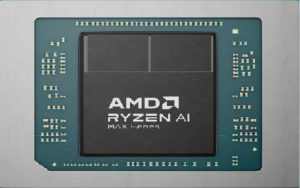
Ryzen AI Max+ 395 Processor
Ryzen AI Max+ 395 Specifications
The Ryzen AI Max+ 395 is a high-performance, AI-focused processor from AMD, offering impressive specs:
- Cores/Threads: 16 Cores / 32 Threads
- Architecture: Zen 5 (Strix Halo)
- Manufacturing Process: 4 nm
- Cache: 64 MB L3
- Graphics: Integrated AMD Radeon 8060S with 40 cores
- Clock Speed: Base at 3 GHz, Boost up to 5.1 GHz
- Total Cache: 80 MB (16 MB L2 + 64 MB L3)
- TDP: 55W (Configurable from 45W to 120W)
- Graphics Frequency: Up to 2900 MHz
- AI Engine: XDNA 2 NPU, with up to 50 TOPS for AI tasks
- System Performance: Up to 126 TOPS
- Memory: 256-bit LPDDR5x, Max Speed LPDDR5x-8000, Max Memory 128 GB
- USB Ports: 2 Native USB 4, 3 USB 3.2 Gen 2
- PCI Express: PCIe 4.0
This processor is designed to deliver top-tier gaming, content creation, and AI acceleration in compact systems like mini PCs and laptops.
How Does the AMD Ryzen AI Max+ 395 Work?
The AMD Ryzen AI Max+ 395 is an advanced processor that combines high-performance components into a single chip. It integrates a powerful RDNA 3.5 GPU, a dedicated AI accelerator (XDNA 2 NPU), and a high-speed Zen 5 CPU.
Thanks to its unified memory architecture, the CPU, GPU, and NPU can all access shared high-bandwidth LPDDR5x memory. This eliminates the need for time-consuming data transfers between different memory pools, speeding up AI inference and improving overall performance.
With this architecture, the processor allows data to be shared seamlessly between the CPU, GPU, and NPU, which leads to faster processing and more efficient handling of large datasets. The NPU works alongside the GPU in hybrid mode, boosting performance in AI tasks, particularly for generative AI applications. This makes it ideal for tasks like content creation, video encoding, and AI processing, offering high efficiency with less power consumption.
Ryzen AI Max+ 395 Architecture
Built on the Strix Halo architecture, the Ryzen AI Max+ 395 packs a powerful combination of components. It features a Radeon 8060S GPU with 40 RDNA 3.5 compute units, a Zen 5 CPU with 16 cores, and an XDNA 2 NPU. Manufactured using TSMC's 4nm process, this processor is designed for AI-accelerated computing. It supports up to 128GB of LPDDR5x memory, offering the high core count and performance needed for demanding tasks.
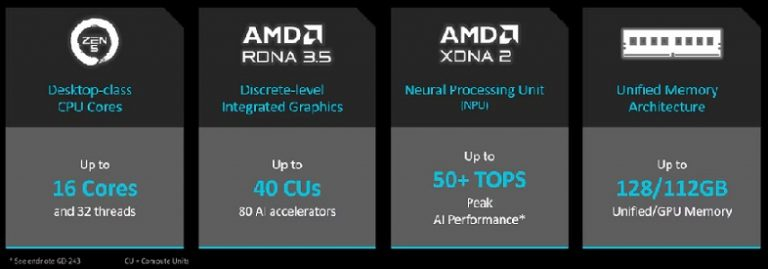
Ryzen AI Max+ 395 Architecture
Architecture Components
The Ryzen AI Max+ 395 processor is built using a combination of advanced components designed for high performance. These components include the CPU, GPU, AI accelerator, memory, cache, manufacturing process, and connectivity. Let’s break them down:
CPU
The Ryzen AI Max+ 395 is powered by 16 Zen 5 CPU cores with 32 threads, delivering base clock speeds ranging from 3.0 GHz to 5.1 GHz. This processor is tailored for AI-accelerated computing, supported by the included Radeon 8060S GPU and XDNA2 NPU, which together deliver up to 126 TOPS of AI performance across the entire system. Built on TSMC’s 4nm FinFET process, it features a robust 80 MB cache and supports up to 128 GB of LPDDR5x-8000 memory, ensuring top-tier performance for complex tasks.
GPU
The Ryzen AI Max+ 395 includes an integrated RDNA 3.5-based graphics processor – the AMD Radeon 8060S with 40 Compute Units (CUs). This GPU delivers desktop-level performance, making it ideal for demanding tasks such as gaming and content creation. It utilizes a portion of the system's unified memory, with up to 96 GB allocated for graphics. In terms of performance, it rivals dedicated graphics cards like the NVIDIA GeForce RTX 4060 Ti, all while sharing memory and power with the CPU cores, offering an efficient and powerful integrated solution.
AI Accelerator
The AI accelerator in the Ryzen AI Max+ 395, powered by the XDNA 2 engine, is a dedicated Neural Processing Unit (NPU) integrated directly into the system-on-chip (SoC). This NPU is specifically designed to accelerate AI workloads such as language models and image generation.
The XDNA 2 accelerator works in sync with the RDNA 3.5 GPU and Zen 5 CPU cores, benefiting from the processor’s unified memory architecture. This integration enhances both performance and efficiency. The XDNA 2 NPU is the core component for AI tasks, optimizing generative AI performance, especially in areas like image generation and processing large language models.
By working alongside the GPU and CPU in hybrid mode, the NPU boosts AI performance by leveraging the combined power of these accelerators. The unified memory pool allows the GPU, NPU, and CPU to share data without the need for exclusive data copies. This shared memory approach leads to more efficient memory usage and faster AI processing.
AI Accelerator
The AI accelerator in the Ryzen AI Max+ 395, powered by the XDNA 2 engine, is a dedicated Neural Processing Unit (NPU) integrated directly into the chip. This NPU is designed to accelerate AI tasks like language processing and image generation.
Working in tandem with the RDNA 3.5 GPU and Zen 5 CPU cores, the XDNA 2 NPU benefits from the processor’s unified memory architecture, which boosts both performance and efficiency. This makes the XDNA 2 NPU the central component for AI tasks, particularly in generative AI applications such as image creation and large language model processing.
By operating in hybrid mode with the GPU and CPU, the NPU maximizes AI performance. The unified memory pool allows the GPU, NPU, and CPU to share data seamlessly, eliminating the need for time-consuming data transfers. This results in better memory utilization and faster AI processing.
Memory & Cache
The AMD Ryzen AI Max+ 395 processor supports up to 128GB of LPDDR5x memory running at 8000MHz. It features a 256-bit memory bus that allows flexible allocation between system and video memory, primarily for the integrated graphics.
The processor includes a total of 80 MB of combined L2 and L3 cache: 16 MB of L2 cache (1 MB per core) and 64 MB of shared L3 cache. This large cache setup improves performance by enabling quicker access to frequently used data.
Manufacturing Process
The Ryzen AI Max+ 395 is built using a multi-chip design on TSMC’s 4nm FinFET process. This involves multiple dies, including CPU cores, GPU, and AI accelerators, all packaged together with an inner I/O die. This architecture is integrated into devices by OEMs like Framework, GEKOM, and HP.
Base Clock & Boost Clock
The base clock speed of the Ryzen AI Max+ 395 is 3.0 GHz, providing consistent performance for everyday tasks like web browsing and document editing. For demanding applications, such as gaming and video editing, the processor can boost up to 5.1 GHz for short bursts, ensuring smooth and responsive performance during high-intensity workloads.
Connectivity
The Ryzen AI Max+ 395 processor offers broad connectivity options, including native support for USB 2.0, USB 3.2 Gen 2, and USB 4, all powered by PCIe 4.0. It also supports high-speed display options like DisplayPort 2.1 and can be configured with ports such as a 5Gb Ethernet and HDMI 2.1. For wireless connectivity, it depends on the specific laptop or motherboard, with common options like Bluetooth 5.3 and Wi-Fi 6E.
Software System
The Ryzen AI Max+ 395 processor is paired with AMD's Adrenalin Edition software, which provides drivers and features for gaming and AI. This software allows developers to run AI models on the integrated NPU or GPU. It supports Windows 10 and future OS updates, along with system-specific drivers, enabling developers to deploy TensorFlow/PyTorch models using ONNX Runtime. The Adrenalin Edition software also offers a user-friendly interface for creators and gamers to manage graphics settings, optimize games, and more.
For AI developers, Ryzen AI software and ONNX Runtime provide the tools to port and run AI models directly on the processor's hardware accelerators. This enables on-device AI inference and high performance, reducing the reliance on cloud computing.
Advantages
The Ryzen AI Max+ 395 offers several notable advantages:
- All-in-One Integration: It eliminates the need for a separate discrete graphics card by combining GPU, CPU, and AI accelerators on a single chip.
- Outstanding Multi-Core Performance: Excellent performance for demanding applications that rely on multi-threading.
- Power Efficiency: Ideal for smaller systems where power and thermal constraints are important, offering impressive power efficiency.
- AI-Driven Speed: The integrated AI engine accelerates AI-driven applications, making it perfect for machine learning and image recognition tasks.
- Creative Performance: Significant performance boosts for creative tools and workloads.
- Compact Systems: Perfect for mini-ITX or small form factor builds where space and power are limited but high performance is still essential.
- Dedicated NPU Acceleration: Ensures improved performance for privacy-focused applications by delivering dedicated NPU acceleration.
- Stable High-End Gaming & Creativity: Provides stable performance for both gaming and professional creative tasks in a compact, power-efficient package.
Disadvantages
Despite its impressive features, the Ryzen AI Max+ 395 has a few downsides:
- Cost: It can be expensive, especially for users who don't need its full AI capabilities.
- Not Suitable for GPU-Heavy Professional Applications: For applications like 3D rendering or CAD that require high-end dedicated graphics, this processor may not suffice.
- Gaming Limitations at High Resolutions: The integrated GPU can’t match the raw power of separate high-end GPUs for gaming at 1440p/4K resolutions with high refresh rates.
- Memory Bandwidth: The GPU shares system RAM via the PCIe bus, which can result in lower bandwidth compared to dedicated VRAM.
- Higher Power Draw: Under full system load, the processor can draw more power, leading to increased heat output and potential fan noise.
- Compatibility Issues: There may be some compatibility challenges with older software or hardware.
Applications
The Ryzen AI Max+ 395 is designed for various use cases, including:
- AI Workloads: Specifically built for running large AI models and AI-driven applications.
- Creative Software Acceleration: Speeds up tasks like video editing and image generation by enhancing AI-powered features.
- Privacy-Sensitive AI: The NPU enables local AI processing, making it ideal for privacy-focused applications and developers creating new AI experiences.
- Healthcare Applications: Useful in healthcare for personalized treatment plans and diagnostic AI.
- Entertainment Industry: Can be used for generating animations and graphics, making it valuable in the creative and gaming sectors.
- High-Performance Gaming: Capable of running current games at higher settings and resolutions (like 1440p) with features such as FSR (FidelityFX Super Resolution).
- Compact Gaming Builds: Perfect for high-performance gaming in living room PCs or mini-ITX systems, though it may still require a separate, larger graphics card for optimal gaming performance.
What is XDNA 2 NPU?
The XDNA 2 NPU (Neural Processing Unit) is a dedicated AI accelerator integrated into the Ryzen AI Max+ 395 processor. It is designed to handle AI workloads more efficiently than a traditional CPU or GPU, providing substantial acceleration for tasks such as machine learning, image recognition, and other AI-driven processes. The XDNA 2 NPU works alongside the processor’s GPU and CPU cores, utilizing the unified memory architecture for improved data access and processing speed. It enables high-performance, on-device AI inference, making it ideal for privacy-sensitive applications and developers looking to deploy AI models locally, without relying on cloud computing.
Related Articles

Christopher Anderson
Christopher Anderson has a Ph.D. in electrical engineering, focusing on power electronics. He’s been a Senior member of the IEEE Power Electronics Society since 2021. Right now, he works with the KPR Institute of Engineering and Technology in the U.S. He also writes detailed, top-notch articles about power electronics for business-to-business electronics platforms.
Subscribe to JMBom Electronics !