

 All Products


Guide to Photodetector
 Jan 09, 2026
 557
557Catalog
What Is a Photodetector?How Does a Photodetector Work?PropertiesPhotodetector TypesPhotodetector Circuit DiagramWorking of the Photodetector CircuitPhotodetector vs PhotodiodeQuantum Efficiency of a PhotodetectorAdvantages and Disadvantages of PhotodetectorsApplications of PhotodetectorsFrequently Ask QuestionsRelated ArticlesA photodetector is a key component in an optical receiver, designed to convert incoming light signals into electrical signals. In most optical communication systems, semiconductor photodetectors—commonly referred to as photodiodes—are the most widely used type. This is because they offer fast response times, high sensitivity, and a compact form factor.
Today, photodetectors are extensively used across a wide range of fields, including industrial electronics, telecommunications, medical and healthcare devices, analytical instruments, automotive systems, transportation, and more. They are also commonly known as photosensors or light sensors. This article provides an overview of photodetectors, explaining how they work and highlighting their key applications.
What Is a Photodetector?
A photodetector is an optoelectronic device that detects incident light or optical power and converts it into an electrical signal. In most cases, the output signal is proportional to the intensity of the incoming light. Photodetectors are essential in a wide range of scientific and practical applications, including process control systems, fiber-optic communications, safety and security equipment, environmental monitoring, and defense technologies. Common examples of photodetectors include photodiodes and phototransistors.

photodetector
How Does a Photodetector Work?
A photodetector operates by sensing light or other forms of electromagnetic radiation, typically by receiving transmitted or reflected optical signals. Semiconductor-based photodetectors work on the principle of electron–hole pair generation when light strikes the material.
When photons with energy equal to or greater than the semiconductor’s bandgap hit the material, they are absorbed and excite electrons from the valence band into the conduction band. This process leaves behind holes in the valence band. The excited electrons and the corresponding holes act as free charge carriers and can move under the influence of an internal or externally applied electric field.
The electron–hole pairs generated by optical absorption may recombine and emit light if no electric field is present. However, when an electric field separates these charge carriers, a photocurrent is produced. This photocurrent represents the portion of photo-generated charge carriers collected at the photodetector’s electrodes. For a given wavelength, the magnitude of the photocurrent is directly proportional to the intensity of the incident light.
Properties
The key properties of photodetectors are outlined below:
- Spectral Response – Describes how the photodetector responds to different photon frequencies or wavelengths of light.
- Quantum Efficiency – Indicates the number of charge carriers generated per incident photon.
- Responsivity – Defined as the ratio of the output current to the total optical power incident on the detector.
Photodetector Types
Photodetectors can be classified according to the physical mechanism used to detect light, such as the photoelectric (photoemission) effect, polarization effect, thermal effect, weak interaction, or photochemical effect. Based on these principles, the main types of photodetectors include photodiodes, MSM (metal–semiconductor–metal) photodetectors, phototransistors, photoconductive detectors, phototubes, and photomultiplier tubes.
Photodiodes
Photodiodes are semiconductor devices built with a PN or PIN junction structure. When light enters the depletion region, it is absorbed and generates a photocurrent. These devices are known for their fast response, high linearity, compact size, and high quantum efficiency—often producing nearly one electron for each incident photon. They also offer a wide dynamic range. To learn more, please refer to the detailed guide on photodiodes.
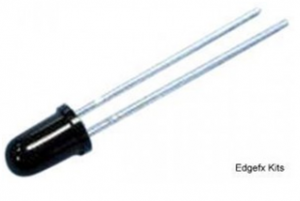
Photo Diode
MSM Photodetectors
MSM (metal–semiconductor–metal) photodetectors use two Schottky contacts instead of a traditional PN junction. Compared to standard photodiodes, these devices can achieve much higher operating speeds, with bandwidths reaching hundreds of gigahertz. MSM photodetectors also support large active areas, making it easier to couple light from optical fibers without significantly reducing bandwidth performance.
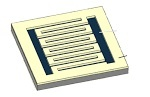
MSM Photodetector
Phototransistor
A phototransistor is a type of photodetector similar to a photodiode but with built-in current amplification. However, it is less commonly used than a photodiode. Phototransistors are mainly used to sense light signals and convert them into digital electrical outputs. They are controlled by incident light rather than an input electrical current. Due to their low cost and high gain, phototransistors are widely used in a variety of applications. For more details, please refer to the dedicated guide on phototransistors.
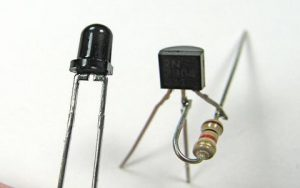
Phototransistor
Photoconductive Detectors
Photoconductive detectors are also referred to as photoresistors, photocells, or light-dependent resistors (LDRs). They are typically made from semiconductor materials such as cadmium sulfide (CdS). These devices consist of a semiconductor layer with two metal electrodes attached, and they operate by detecting changes in resistance when exposed to light.
Compared to photodiodes, photoconductive detectors are less expensive but generally slower in response, less sensitive, and more nonlinear in their output characteristics. However, they are capable of responding to longer-wavelength infrared (IR) light. Based on their spectral responsivity, photoconductive detectors are categorized into types designed for the visible spectrum, near-infrared range, and infrared range.
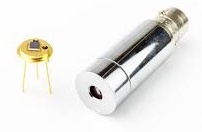
Photoconductive Detector
Phototubes
Phototubes are vacuum or gas-filled tubes used as photodetectors. They are photoemissive devices that operate based on the external photoelectric (photoemission) effect. In these tubes, light striking the photosensitive surface causes electrons to be emitted. Phototubes are typically evacuated, although some are filled with low-pressure gas to enhance performance in specific applications.
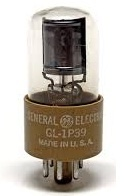
Phototube
Photomultiplier
A photomultiplier is a specialized type of phototube that converts incoming photons into an electrical signal. These detectors use an electron multiplication process to significantly amplify the output, resulting in very high responsivity. Photomultipliers typically feature a large active area and fast response. Several types of photomultipliers are available, including standard photomultiplier tubes, magnetic photomultipliers, electrostatic photomultipliers, and silicon photomultipliers.
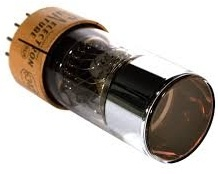
Photomultiplier
Photodetector Circuit Diagram
The diagram below shows a basic light-sensing circuit using a photodetector. In this setup, a photodiode acts as the photodetector, detecting whether light is present or absent. The sensitivity of the sensor can be easily adjusted using the preset.
Key components used in this light sensor circuit include:
- Photodiode
- LED
- LM339 IC (Comparator)
- Resistors
- Preset (for sensitivity adjustment)
To assemble the circuit, connect all components as shown in the diagram below. The photodiode detects light, and the LM339 compares the photodiode signal against a reference set by the preset, turning the LED on or off accordingly.
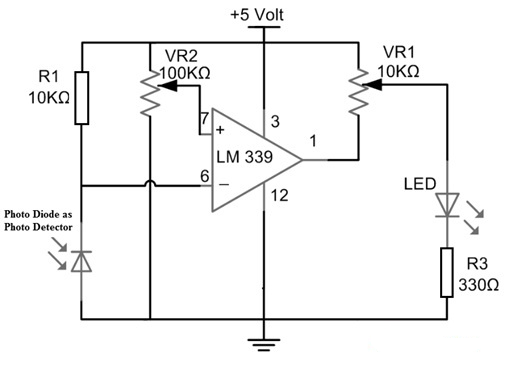
Light Sensor Circuit using Photodiode as Photodetector
Working of the Photodetector Circuit
In this circuit, a photodiode acts as the photodetector and generates a current when light falls on it. The photodiode is connected in reverse bias through resistor R1, which limits the current to protect the diode when exposed to strong light.
- No light condition: When no light falls on the photodiode, the voltage at pin 6 (inverting input) of the LM339 comparator is high.
- Light condition: When light hits the photodiode, current flows through it, causing the voltage across the photodiode to drop. The comparator’s non-inverting input (pin 7) is connected to a variable resistor (VR2) to set a reference voltage.
The comparator operates as follows: when the voltage at the non-inverting input is higher than the inverting input, the comparator’s output goes high. The output (pin 1) is connected to an LED, and a preset (VR1) sets the reference voltage corresponding to a threshold light level.
- When light falls on the photodiode, the voltage at the inverting input drops below the reference voltage at the non-inverting input.
- As a result, the comparator output turns high, supplying forward bias to the LED, which turns it ON.
In short, this circuit lights up the LED whenever the photodiode detects light above a certain threshold set by the presets.
Photodetector vs Photodiode
Here’s a clear comparison between a photodetector and a photodiode:
| Feature | Photodetector | Photodiode |
|---|---|---|
| Definition | A general photosensor that detects light | A light-sensitive semiconductor diode |
| Use of Amplifier | Typically does not use an amplifier | Often uses an amplifier to detect low light levels (leakage current changes with light) |
| Construction | Made from compound semiconductors (e.g., 0.73 eV bandgap) | Made from P-type and N-type semiconductors |
| Speed | Slower response | Faster response |
| Sensitivity | More sensitive | Less sensitive |
| Function | Converts photon energy into an electrical signal | Converts light energy and measures brightness |
| Temperature Range | 8 K – 420 K | 27°C – 550°C |
Quantum Efficiency of a Photodetector
Quantum efficiency (η) is the fraction of incident photons absorbed by the photodetector that generate electrons collected at its terminals. It is a measure of how effectively the device converts light into an electrical signal.
Mathematically:η=Generated electronsTotal incident photons\eta = \frac{\text{Generated electrons}}{\text{Total incident photons}}η=Total incident photonsGenerated electrons
Or expressed in terms of measurable quantities:η=Iph/ePD/(hc/λ)\eta = \frac{I_\text{ph}/e}{P_D / (hc/\lambda)}η=PD/(hc/λ)Iph/e
Where:
- IphI_\text{ph}Iph = photocurrent
- eee = electron charge
- PDP_DPD = incident optical power
- hhh = Planck’s constant
- ccc = speed of light
- λ\lambdaλ = wavelength of incident light
This equation shows that the quantum efficiency depends on both the electrical output of the photodetector and the energy of the incident photons.
Advantages and Disadvantages of Photodetectors
Advantages
- Compact and small in size
- Fast detection speed
- High detection efficiency
- Low noise generation
- Affordable, lightweight, and compact
- Long operational lifetime
- High quantum efficiency
- Do not require high voltage
Disadvantages
- Low sensitivity
- No internal gain
- Slow response time
- Small active area
- Small current changes, which may be insufficient to directly drive a circuit
- Requires an offset voltage
Applications of Photodetectors
Photodetectors have a wide range of applications across everyday devices and advanced scientific instruments:
- Used in automatic doors, TV remote controllers, and other household electronics
- Essential in optical communications, security systems, night vision, video imaging, biomedical imaging, motion detection, and gas sensing, converting light into electrical signals
- Measure optical power and luminous flux
- Incorporated in various microscopes and optical sensor designs
- Key components in laser rangefinders and frequency metrology
- Widely used in optical-fiber communications, photometry, and radiometry to measure optical power, intensity, irradiance, and luminous flux
- Applied in spectrometers, optical data storage devices, light barriers, beam profilers, fluorescence microscopes, autocorrelators, interferometers, and other optical sensors
- Utilized in LIDAR, night vision devices, quantum optics experiments, and laser noise classification
- Two-dimensional arrays of photodetectors, known as focal plane arrays, are used extensively in imaging applications
Frequently Ask Questions
What is a photodetector used for?
Photodetectors are used to convert the energy of incoming photons (light) into an electrical signal.
What are the characteristics of a photodetector?
Key characteristics of photodetectors include:
- Photosensitivity
- Spectral response
- Quantum efficiency
- Forward-biased noise
- Dark current
- Noise-equivalent power (NEP)
- Timing response
- Terminal capacitance
- Cutoff frequency
- Frequency bandwidth
What are the requirements of a photodetector?
A good photodetector should have:
- Short response times
- Minimal noise contribution
- High reliability
- High sensitivity
- Linear response across a wide range of light intensities
- Low bias voltage
- Low cost
- Stable performance characteristics
What specification is commonly used for optical detectors?
Noise-equivalent power (NEP) is often used because it represents the optical input power needed to generate an output signal equal to the detector’s noise level for a given bandwidth.
Are quantum yield and quantum efficiency the same?
No, they are different:
- Quantum yield is the probability that a photon will be emitted once a photon has been absorbed.
- Quantum efficiency is the probability that a photon will generate a charge carrier (electron) once the system is energized to its emitting condition.
This provides a clear overview of photodetectors, their working, properties, requirements, and specifications. These devices rely on internal and external photoelectric effects, making them essential for light detection.
You asked, “What are optical detectors?”
Optical detectors are devices that sense or measure light (optical signals) and convert it into a usable electrical signal. Photodetectors are a type of optical detector. Other examples include phototransistors, photomultiplier tubes, and photoconductive cells. Optical detectors are widely used in communications, sensing, imaging, and scientific instrumentation.
Related Articles
Diode Dynamics: Real-World Behavior in Fast Power and RF Circuits

Christopher Anderson
Christopher Anderson has a Ph.D. in electrical engineering, focusing on power electronics. He’s been a Senior member of the IEEE Power Electronics Society since 2021. Right now, he works with the KPR Institute of Engineering and Technology in the U.S. He also writes detailed, top-notch articles about power electronics for business-to-business electronics platforms.
Subscribe to JMBom Electronics !