

 All Products


SL2002 Laser Driver IC
 Dec 30, 2025
 649
649Catalog
What Is the SL2002 Laser Driver IC?SpecificationsSL2002 Laser Driver IC ArchitectureComponentsHow Does the SL2002 IC Work?Advantages and DisadvantagesSL2002 Laser Driver IC ApplicationsFAQRelated ArticlesOn June 19, 2025, Silanna Semiconductor launched the SL2002 laser driver IC as part of its FirePower product family. This device is purpose-built for cost-effective, compact, and battery-powered ranging and measurement systems.
As the latest addition to the FirePower series, the SL2002 is optimized for low-voltage operation in space-constrained designs. It delivers high-performance laser output while running from a standard 3V battery, making it ideal for portable applications. With its high level of integration, excellent efficiency, and strong output capability, the SL2002 sets a new benchmark for energy- and space-limited laser systems.
This article takes a closer look at the SL2002 laser driver IC, explaining how it works and where it is commonly used.
What Is the SL2002 Laser Driver IC?
The SL2002 is a laser driver IC from Silanna Semiconductor’s FirePower™ family, housed in a compact 14-pin WLCSP package with a footprint of just 3.5 mm². It is specifically designed for low-voltage operation in small, space-constrained systems and can run directly from a standard 3V battery supply.
This IC integrates high-current laser diode pulsing and resonant capacitor charging onto a single chip. As a result, the SL2002 can generate light pulses with peak power exceeding 1,000 W, while achieving up to 86% efficiency from input voltage to laser output. It is intended to support the development of affordable, compact, battery-powered ranging and distance-measurement systems.
Specifications
The key specifications of the SL2002 laser driver IC are outlined below:
- The SL2002 is a high-performance laser driver IC.
- It comes in a compact 14-pin WLCSP package.
- It operates directly from a standard 3V battery, with no external boost circuitry required.
- High-current laser pulsing and resonant capacitor charging are integrated on a single chip.
- It delivers more than 1,000 W of peak laser pulse power.
- It achieves up to 86% efficiency from input voltage to laser output.
- It helps lower the bill of materials by eliminating the need for external discrete components.
- It reduces PCB area and simplifies overall system design.
- A complete evaluation kit is available to support rapid development and testing.
SL2002 Laser Driver IC Architecture
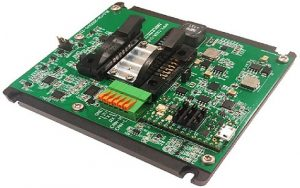
The architecture of the SL2002 laser driver IC mainly consists of a constant current source, along with a laser diode connection and built-in ESD protection. It uses a single WLCSP device to generate high-power light pulses, which significantly reduces the need for external components. The SL2002 also includes integrated control functions and a modulation input for flexible operation.
In addition, the SL2002 laser driver IC combines resonant capacitor charging and high-current laser diode pulsing on the same chip. This high level of integration minimizes the number of external discrete components, simplifying the overall design and reducing power losses. Its compact wafer-level chip-scale package (WLCSP), optimized for low-voltage operation, enables strong laser performance while running from a standard 3V battery.
SL2002 Laser Driver IC Architecture
Components
The main components of the SL2002 laser driver IC and their design considerations are outlined below:
Constant Current Source
The constant current source is a core element of the laser driver IC. It provides a stable, well-controlled current to the laser diode, ensuring consistent optical output and helping to prevent damage to the device.
Laser Diode Mount
The laser diode mount offers a secure and thermally efficient way to house the laser diode. It ensures proper alignment and effective heat dissipation during operation.
ESD Protection
Laser diodes are highly sensitive to electrostatic discharge. The SL2002 includes built-in ESD protection circuitry to safeguard the device from ESD-related damage.
Integrated Controls
On-chip control circuitry simplifies the overall system design and reduces the need for additional external components.
Modulation Input
The modulation input enables control of the laser output, supporting applications such as pulsed operation for range-finding and distance measurement.
Resonant Capacitor Charging
The SL2002 uses resonant capacitor charging to generate high-current laser pulses efficiently. This approach allows the IC to deliver peak pulse power above 1 kW while operating from a standard 3V battery.
Low-Voltage Operation
The IC is designed to run directly from low-voltage battery supplies commonly used in portable devices, simplifying the power supply design.
High Efficiency
With up to 86% input-to-laser efficiency, the SL2002 helps extend battery life in portable and battery-powered applications.
Compact Packaging
The device is packaged in a compact WLCSP format, minimizing PCB area and making it well suited for space-constrained designs.
Optional External Components
Although the SL2002 significantly reduces the need for external parts, some applications may still require a small number of passive components, such as resistors or capacitors, for specific configurations.
Overall, the SL2002 laser driver IC streamlines laser driver design by integrating critical functions and minimizing external components. This results in smaller, more efficient, and cost-effective laser systems, particularly for portable applications.
How Does the SL2002 IC Work?
The SL2002 laser driver IC operates by combining resonant capacitor charging and high-current laser diode pulsing on a single chip. This integrated architecture greatly reduces the need for external discrete components, resulting in smaller, more efficient, and more cost-effective laser systems—especially in portable applications such as rangefinders and 3D mapping devices.
The IC efficiently charges a capacitor using a low-voltage battery supply and then precisely delivers controlled current to the laser diode. This approach enables high-power, pulsed laser operation while maintaining excellent efficiency, even when powered by a typical low-voltage battery.
The working principle of the SL2002 IC can be explained as follows:
Resonant Capacitor Charging
The SL2002 uses a resonant charging circuit to store energy efficiently in a capacitor. This method minimizes power loss during charging, improving overall efficiency and enabling the generation of high-power laser pulses from a low-voltage 3V battery supply.
High-Current Laser Operation
Once charged, the capacitor rapidly discharges into the laser diode to produce short, high-power light pulses. The SL2002 precisely controls both the discharge timing and the current level, ensuring consistent pulse shape and optimal laser performance. This capability is especially important for LiDAR applications, where accurate and repeatable pulses are critical.
Single-Chip Integration
By integrating both the charging and laser-firing functions on a single chip, the SL2002 greatly reduces the need for external components. This high level of integration enables smaller, more compact designs while lowering system cost through reduced PCB area and part count.
Efficiency Advantages
The SL2002 achieves high input-to-laser efficiency, meaning a large portion of the supplied electrical power is converted into usable optical output. This efficiency is a major advantage in battery-powered devices, as it helps extend battery life and reduces overall power consumption.
Advantages and Disadvantages
Advantages
The key advantages of the SL2002 laser driver IC include the following:
- High efficiency, compact size, and simplified system design
- Up to 86% efficiency, helping extend battery life in portable devices
- Small form factor that supports system miniaturization
- High level of integration reduces the need for external components, simplifying design and lowering overall cost
- Generates laser light pulses with peak power exceeding 1,000 W
- Operates directly from a standard 3V battery, making it suitable for a wide range of portable applications
- Integrates multiple functional blocks on a single chip
- Well suited for space-limited applications such as mobile sensors and wearable devices
- Optimized for low power consumption in battery-powered systems
- Reduces energy loss and extends battery life by eliminating the need for large external boost circuits
- Includes a soft-start feature to protect the laser diode during initial power-up
- Adjustable current limiting helps prevent overcurrent conditions, improving laser lifetime and system reliability
- Mechanical shorting relay and latching current limit enhance robustness in real-world operating conditions
- Supports both pulsed and continuous-wave operation
Disadvantages
The main limitations of the SL2002 laser driver IC include the following:
- Constraints on maximum operating voltage and current
- Potential EMC/EMI issues or self-oscillation if the circuit is not carefully designed
- Despite simplifying system design, careful attention is still required for component selection and thermal management
- Heat is generated during operation, making proper thermal design essential, especially in high-power applications
- Although many functions are integrated, some external components such as resistors and capacitors are still required, and their selection can impact stability and performance
- Certain applications may require additional compensation networks or more complex control schemes to achieve optimal performance and system density
SL2002 Laser Driver IC Applications
The SL2002 laser driver IC is well suited for a wide range of applications that require efficient, compact, and battery-powered laser driving. Typical use cases include:
- Portable systems that demand high efficiency and a small footprint for laser operation
- Next-generation rangefinders, industrial sensors, and portable 3D mapping equipment that operate from low-voltage power supplies
- Mobile mapping systems that benefit from compact size and efficient operation from a standard 3V battery
- Sports and industrial rangefinders, enabling smaller and more energy-efficient designs
- Industrial sensing applications that rely on laser-based measurement and detection
- Optical scopes and similar devices that require accurate and efficient laser triggering
- Applications that need high peak-power laser pulses while operating from a low-voltage supply
In summary, the SL2002 laser driver IC is designed for compact, high-efficiency laser driving applications. By integrating resonant capacitor charging and high-current laser diode pulsing on a single chip, it eliminates many external components. This integration results in a smaller PCB footprint, lower bill of materials, and reduced power losses. The SL2002 delivers laser pulses exceeding 1,000 W peak power while achieving up to 86% input-to-laser efficiency.
FAQ
What Is a Laser Diode?
A laser diode is a semiconductor device that emits coherent, focused light when an electric current passes through it. It is widely used in applications such as rangefinding, sensing, optical communication, and scanning because it can produce precise, high-intensity light in a compact and energy-efficient form.
Related Articles
Diode Dynamics: Real-World Behavior in Fast Power and RF Circuits

Christopher Anderson
Christopher Anderson has a Ph.D. in electrical engineering, focusing on power electronics. He’s been a Senior member of the IEEE Power Electronics Society since 2021. Right now, he works with the KPR Institute of Engineering and Technology in the U.S. He also writes detailed, top-notch articles about power electronics for business-to-business electronics platforms.
Subscribe to JMBom Electronics !