

 All Products


Transfer Switches: Operation and Applications
 Mar 30, 2026
 592
592Catalog
What is a transfer switch?How Does a Transfer Switch Work?Types of Transfer SwitchesTransfer Switch Wiring DiagramHow to Install a Transfer SwitchHow Do I Use a Transfer Switch?Advantages and DisadvantagesApplicationsRelated ArticlesHospitals, commercial buildings, data centers, and other critical facilities typically rely on emergency power sources such as standby generators or alternate utility feeds in the event of a power outage.
A transfer switch addresses this need by enabling the safe, rapid switching of electrical power supply between two sources—normal mains power and emergency backup power—for all connected systems and equipment.
This article provides an overview of transfer switches, including their operating principles and practical applications.
What is a transfer switch?
A transfer switch is a device designed to safely connect or disconnect multiple power sources to an electrical load. Backup generators are commonly used in residential and commercial settings to provide emergency power. For this reason, a transfer switch is installed alongside the generator to supply temporary electricity in the event of a mains power failure.
These switches facilitate power switching between a generator and the utility grid, between multiple generators, or between different utility supply inputs.
How Does a Transfer Switch Work?
The operating principle of a transfer switch relies on rapid switching between power sources. It enables fast and secure electrical switching between a primary power source and a backup source, ensuring uninterrupted power supply.
A transfer switch is an intelligent, automatic power-switching device whose primary function is to maintain consistent power delivery to connected load circuits from one of the two available sources. Typical loads include motors, lighting systems, computers, and other critical equipment.
The transfer switch detects a power loss by monitoring load current and voltage levels. Loads such as motors and furnace blowers draw high operating current. When a power interruption occurs, these devices stop operating as voltage and current are removed. Upon power restoration, the motor draws a high inrush current during startup, which must be controlled to avoid equipment damage.
The transfer switch monitors this inrush current by simultaneously measuring the voltage across the load and the current flowing through it. When power to the load is lost, both voltage and current drop to zero. When power is restored, the inrush current surge is limited by activating internal relays before full voltage is reapplied to the system.
Types of Transfer Switches
A variety of transfer switch models are commercially available, which are categorized as follows.
Manual Transfer Switches
A manual transfer switch is a device that requires manual operation to switch the load between two power sources—typically the utility mains and a backup generator.
This type of switch directly connects a building’s electrical circuits to the standby generator. During a power outage, it allows the connected loads to run on backup power until utility service is restored.
Manual transfer switches are suitable for both indoor and outdoor installation.
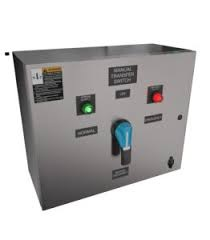
Manual Transfer Switch
Manual transfer switches are straightforward and more cost-effective compared to automatic models. However, they are prohibited in certain safety‑critical applications where rapid power source switching is required, regardless of whether personnel are present.
Automatic Transfer Switches
An automatic transfer switch, commonly referred to as an ATS, is a self‑operating device that automatically switches the power supply from the primary source to a backup source upon detecting a mains outage. When a failure occurs in the primary power system, this switch ensures an uninterrupted power supply to the connected loads.
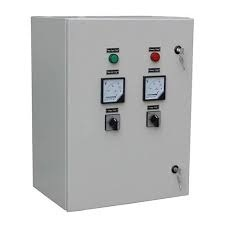
Automatic Transfer Switch
Since the ATS is connected to both power sources, it acts as an intermediary between the power supplies and the connected equipment, functioning similarly to an electrical relay.
Leading manufacturers of automatic transfer switches include APC, Cummins Power Generation, Western Telematic, and General Electric.
Transfer Switch Wiring Diagram
Hospitals, data centers, manufacturing facilities, and a wide range of commercial and institutional applications typically require an emergency power source—such as a backup utility feed or generator—when the normal mains supply is interrupted.
A transfer switch ensures the safe and rapid switching of all electrical power supplied to circuits, systems, or equipment connected to its output between the normal and emergency power sources.
In this context, the electrical equipment, systems, or circuits powered through the switch output are referred to as the load.
The transfer switch wiring diagram is illustrated below. A typical transfer switch sequence includes the following steps.
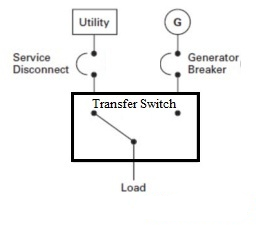
Transfer Switch Wiring Diagram
When the normal power source becomes unavailable or fails, the transfer switch will connect the electrical load to the emergency power source—provided the generator starts and the backup utility supply remains stable within acceptable voltage and frequency tolerances.
Depending on facility requirements and user preferences, this power transfer can occur either manually or automatically.
Once utility power is restored, the switch will reconnect the load from the emergency power source back to the normal mains supply. Again, this process can be manual or automatic, based on the switch type and its operating mode.
How to Install a Transfer Switch
Installing a transfer switch is straightforward if you follow proper procedures and observe essential safety precautions. The steps below will guide you through the installation process:
- Determine the number of circuits required for your setup.First, identify how many circuits will be supplied by the generator. Each circuit should be protected by its own dedicated circuit breaker or fuse.For instance, if you intend to connect three circuits to your generator—one for lighting and two for appliances such as a refrigerator and furnace blower motor—you will need three breakers or fuses installed in your home’s electrical panel.
- Ensure sufficient space is available in your electrical panel for additional breakers or fuses, as well as for connecting generator extension cords.If adequate space is not available, you may need to install a supplementary breaker panel outside your home for the generator connection.It is advisable to consult a licensed electrician before proceeding with this step.
How Do I Use a Transfer Switch?
A transfer switch provides flexible control over the direction of power distribution within your property. For example, if you have a standby generator, you can use a transfer switch to automatically energize selected lighting circuits when the generator activates during a power outage.
In the event of a local neighborhood blackout, it also helps protect electrical equipment by isolating sensitive appliances from the grid until utility power is fully restored.
Advantages and Disadvantages
Advantages of Transfer Switches
- Automatic Transfer Switches (ATS) are essential for maintaining an uninterrupted power supply.
- They enable highly efficient switching to generator power.
- They are ideal for use with generators in hard-to-reach locations.
- ATS systems deliver significant benefits to commercial operations, including enhanced safety, operational simplicity, and high reliability.
- They automatically transfer the electrical load from the main power supply to the generator, ensuring a seamless transition.
- ATS units feature built-in sensors that monitor fluctuations in supply voltage and frequency.
- They incorporate time-delay mechanisms that safeguard both the generator and connected electrical circuits from power surges and irregularities.
Disadvantages of Transfer Switches
- Automatic transfer switches may occasionally respond to false power-failure signals.
- They are more expensive than manually operated transfer switches.
- ATS units require more frequent maintenance compared to manual models.
Applications
- Transfer switches prevent backfeeding, a dangerous condition where electricity flows from a home generator back into the public utility grid.
- They are integrated with circuit breakers to enhance the protection of household electrical appliances.
- They play a critical role in safeguarding both utility mains and generator power systems.
- They are commonly used to operate small standby generators in residential settings and small industrial facilities.
- ATS units facilitate automatic power transfer between a primary utility source and a backup generator.
- They also support other power-switching configurations, such as utility-to-utility, generator-to-generator, and three-source power systems.
- They provide reliable switching of electrical loads between dual power sources.
- They allow homeowners to utilize their existing internal wiring to quickly and safely power any connected appliance via a generator.
- They enable loads to seamlessly connect to either utility mains or backup power sources.
This completes the overview of transfer switches, including their classification, operating principles, and practical applications.These devices support multiple operating modes and transition types, utilizing a variety of switching mechanisms.They are capable of rapidly controlling and switching between two power sources during a mains failure.
Here is a question for you: What is an alternative term for a transfer switch?
Related Articles
What is a Manual Transfer Switch: Working Principle & Applications
What is a Membrane Switch? Working Principle and Applications

Amanda Miller
Amanda Miller is a senior electronics engineer with 6 years of experience. She focuses on studying resistors, transistors, and package design in detail. Her deep knowledge helps her bring innovation and high standards to the electronics industry.
Subscribe to JMBom Electronics !