

 All Products


Energy Stored in a Capacitor: Derivation and Applications
 Mar 13, 2026
 470
470Catalog
What Is Energy Stored in a Capacitor?Derivation of Energy Stored in a CapacitorEnergy Stored in Capacitors: Series and Parallel ConfigurationsAdvantages and DisadvantagesApplicationsIn SummaryRelated ArticlesA capacitor is a two-terminal electrical component consisting of two conductive plates placed parallel to each other and separated by an insulating dielectric material. Its primary role is to store electrical energy, with common applications including voltage surge suppression, signal filtering, and energy storage. This article explains how energy is stored in a capacitor, along with its derivation and practical uses.
What Is Energy Stored in a Capacitor?
A capacitor stores energy in the electric field between its two plates. When connected to a battery, the capacitor charges, building up an electric field across the dielectric. Once disconnected from the battery, the energy remains stored in the electric field within the gap between the plates.
Derivation of Energy Stored in a Capacitor
The energy storage mechanism in a capacitor can be derived as follows. When a DC voltage source is connected across the capacitor plates, the device charges, causing positive charge to accumulate on one plate and an equal amount of negative charge on the opposite plate. Because the charges are separated by a dielectric, an electric field acts against their movement. As long as the applied voltage remains constant, the charges stay stationary on their respective plates.
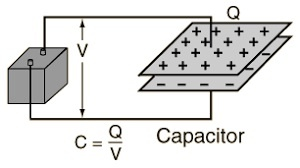
Energy Stored in the Capacitor Diagram
As charge accumulates, the potential difference across the capacitor plates gradually increases. Conversely, when the capacitor discharges, this potential difference drives current in the opposite direction.
The energy stored in a capacitor—its electric potential energy—depends on the charge and voltage across the device. Consider a conductor with capacitance C that is initially uncharged. When connected to a battery, it develops a potential difference V. Let q be the charge on one plate; by definition:
q=CV
Work done is the product of charge and potential, so W=Vq. For a small increment of charge dq delivered by the battery at potential V, the differential work is:
dW=Vdq=Cqdq
The total work done in charging the capacitor to a final charge q is therefore:
W=C1∫0qqdq=C1[2q2]=2Cq2
This work equals the energy stored in the capacitor:
U=2Cq2
Substituting q=CV:
U=21CV2
Substituting C=Vq:
U=21qV
The stored energy can be written equivalently as:
Ecap=2QV=2CV2=2CQ2
where:
- Q = charge (coulombs, C)
- V = voltage (volts, V)
- C = capacitance (farads, F)
- Energy E is in joules (J) when these SI units are used.
Energy Stored in Capacitors: Series and Parallel Configurations
Series Connection
When capacitors C1, C2, and C3 are connected in series, the same charge q accumulates on each capacitor. Let Ctotal be the equivalent capacitance of the series combination.
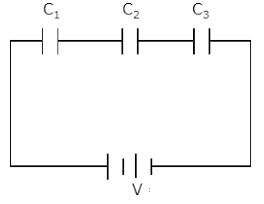
Capacitors in Series Connection
C1=C11+C21+C31
Let the total energy stored in the series combination be W. Then:
W=21Cq2
Substituting the reciprocal capacitance:
W=21q2(C11+C21+C31)
This can be rewritten as the sum of energies stored in each capacitor:
W=W1+W2+W3
Energy Stored in a Parallel Combination
When capacitors C1, C2, and C3 are connected in parallel, they all charge to the same voltage V. Let Ctotal be the equivalent capacitance of the parallel combination. Then:
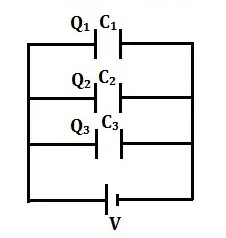
C=C1+C2+C3
Let the total energy stored in the parallel combination be W. Then:
W=21CV2
Substituting the total capacitance:
W=21(C1+C2+C3)V2
This can also be expressed as the sum of the individual energies:
W=W1+W2+W3
Thus, the total energy stored in any capacitor network (series, parallel, or mixed) equals the sum of the energies stored in each individual capacitor.
Example 1
A capacitor with C=30 F is charged to V=100 V. Calculate the stored energy.
U=21CV2
Substituting values:
U=21×30×(100)2=150×103 J
Example 2
A 12 V battery is connected to three capacitors in series: 10 μF, 10 μF, and 20 μF. Find the total stored energy.
First, find the equivalent capacitance:
C1=C11+C21+C31
C1=101+101+201=202+2+1=205=41
C=4 μF=4×10⁻⁶ F
Now calculate the stored energy:
U=21CV2
U=21×4×10−6×(12)2=2×144×10−6=288×10−6 J
Advantages and Disadvantages
Advantages of Capacitive Energy Storage
- Capacitors charge and accumulate energy very quickly.
- They can discharge stored energy at a high rate.
- They exhibit lower energy losses compared to many other storage devices.
- They require minimal maintenance.
- They have a long service life.
Disadvantages of Capacitive Energy Storage
- Capacitors have a lower energy density compared to batteries.
- They offer limited energy storage per unit cost.
- Stored energy gradually decreases over time due to internal leakage.
Applications
Common applications of energy stored in capacitors include:
- Supplying power to devices such as defibrillators, camera flashes, calculators, and other microelectronic systems.
- Delivering energy much faster than batteries, resulting in higher power density for the same stored energy.
- Use in battery-powered electronic circuits to prevent data loss during battery replacement.
- Essential roles in power supply circuits, including current stabilization and AC-to-DC conversion in adapters.
- Buffering against voltage fluctuations to maintain steady current output and stabilize variable AC signals.
- Use in uninterruptible power supplies (UPS), audio equipment, lasers, magnetic coils, and other pulsed-load systems.
- High-capacity energy storage using supercapacitors for heavy‑duty applications.
In Summary
In summary, the energy stored in a capacitor represents the work required to charge it, with energy held in the electric field between the two plates. This stored energy depends on the amount of charge on the plates and the potential difference across them.
Question for review: What is capacitance?
Related Articles
Diode Dynamics: Real-World Behavior in Fast Power and RF Circuits

Christopher Anderson
Christopher Anderson has a Ph.D. in electrical engineering, focusing on power electronics. He’s been a Senior member of the IEEE Power Electronics Society since 2021. Right now, he works with the KPR Institute of Engineering and Technology in the U.S. He also writes detailed, top-notch articles about power electronics for business-to-business electronics platforms.
Subscribe to JMBom Electronics !