

 All Products


What is a Constant Current Diode? Working Principle & Applications
 Mar 10, 2026
 439
439Catalog
What is a constant current diode?Constant Current Diode: Construction & WorkingFeaturesConstant Current Diode CircuitConstant Current Diode CharacteristicsConstant Current Diode: Advantages, Disadvantages & ApplicationsRelated ArticlesA diode is a polarized, two-terminal electronic device that allows current to flow in one direction while blocking it in the reverse direction. Ideally, it has zero resistance in the forward direction and infinite resistance in the reverse direction. Diodes feature two terminals: an anode and a cathode.
There are many different types of diodes used in electrical and electronic projects to suit various requirements, including PN-junction diodes, Zener diodes, constant current diodes, Schottky diodes, light-emitting diodes (LEDs), and others.
This article focuses on constant current diodes—one specific category of diode—explaining their working principle and applications.
What is a constant current diode?
A constant current diode (CCD)—also referred to as a current-regulating diode (CRD) or current-limiting diode (CLD)—is a diode designed to maintain or regulate current at a fixed, predetermined level, regardless of changes in voltage or load conditions. Its circuit symbol is shown below.
A key function of the constant current diode is to protect the circuit against short circuits and excessive current fluctuations.
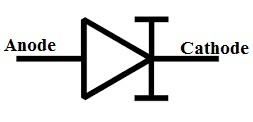
Constant Current Diode Symbol
Constant Current Diode: Construction & Working
The internal structure of a constant current diode is shown below. This diode uses an N‑channel JFET, with the gate connected directly to the source. This configuration turns the device into a two‑terminal current limiter or current source, similar in function to how a Zener diode acts as a voltage regulator.
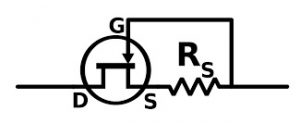
Diode Construction
Unlike Zener diodes, which maintain a constant voltage, these diodes keep the current stable. Even when the applied voltage varies, the current through the diode remains nearly unchanged.
Constant current diodes operate in forward bias with a typical voltage range of 1.5 V to 6 V. The current produced under this bias is known as the forward current IP. The diode can maintain this current value even with fluctuations in the input voltage or load resistance.
Features
Key features of a constant current diode include:
- Tolerance: ±10%
- Operating voltage range: 1 V to 100 V
- Stable performance over varying temperatures
- Peak operating voltage: 100 V
- Thermal resistance: 100 °C/W
- Storage temperature range: -55 °C to 200 °C
- Power dissipation: 30 mW
- Current range: 0.192 mA to 5.6 mA
- Peak voltage rating: 50 V to 100 V
- Impedance: from several kilo-ohms up to 20 MΩ
- Requires no external biasing
- Excellent temperature stability
Constant Current Diode Circuit
As its name implies, a constant current diode regulates current flow to a fixed level.
If the current through the diode exceeds its regulation point, the device compensates by increasing the voltage drop across itself. A typical application circuit is shown below.
These diodes are widely used in LED or laser diode circuits to limit the current passing through the LED or laser.
The circuit consists of a battery, a constant current diode, and a laser diode or LED, connected in series.
When voltage is applied from the power source, the constant current diode limits the current and delivers the appropriate drive current to the laser or LED, turning the device on.
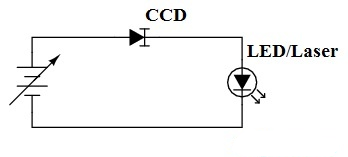
Constant Current Diode Circuit
Here, the regulation point of the diode must be chosen to match the forward current requirement of either the LED or, more importantly, the laser diode.
This is especially critical for laser diodes, but less so for standard LEDs, as conventional LEDs are generally more tolerant of variations in forward current.
Another common application of constant current diodes is charging small secondary batteries.
Constant Current Diode Characteristics
Key characteristics of a constant current diode include the following.
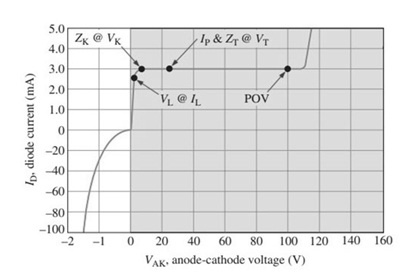
Constant Current Diode Characteristics
The characteristic curve of the constant current diode (shown above) is divided into distinct operating regions.
In the diagram provided, the right-hand portion of the curve corresponds to the forward bias operating condition. Within this region, the forward current remains stable when the applied voltage ranges from 0V to 6V.
This stabilized current is referred to as the regulator current, denoted as \(I_P\). For instance, the regulator current values for the 1N5283 to 1N5314 diode series range from 220 μA to 4.7 mA (note: corrected from 220 mA to 220 μA for technical accuracy, as 220 mA would exceed typical ratings for this series).
These diodes can be used in parallel combinations to achieve a higher total current output.
Unlike most other diodes, constant current diodes can also function under reverse bias conditions. In forward bias, the diode’s current regulation process begins at the limiting voltage (\(V_L\)) and extends up to the peak operating voltage (POV).
From the characteristic curve, it can be observed that the current remains stable between two points: \(V_K\) and POV.
\(V_T\) (test voltage) is the specified voltage at which the regulator current (\(I_P\)) and dynamic impedance (\(Z_T\)) are measured.
For the 1N5283 to 1N5314 diode series, the dynamic impedance (\(Z_T\)) ranges from 235 kΩ to 25 MΩ.
Constant Current Diode: Advantages, Disadvantages & Applications
Advantages
- No additional voltage source is required.
- The circuit design is extremely simple.
- These diodes maintain a stable current output despite voltage fluctuations.
- They are compact and lightweight.
- They operate continuously at low voltages and offer protection against high-voltage harmonics.
Disadvantages
- These diodes only function under forward-bias conditions.
- They are temperature-sensitive, particularly at high temperatures.
- They exhibit a relatively slow response time.
- They produce higher noise levels at high frequencies.
Applications
- Used in various circuits, including battery chargers, timers, and waveform generators.
- Commonly employed as constant-current sources, especially for driving LEDs.
- Replace holding coils in telephone equipment.
- Suitable for circuits with long LED strings and voltage-variable devices such as lamps.
- Used for current regulation, much like Zener diodes are used for voltage regulation.
- Provide input signals for solid-state relays.
- Offer circuit protection against overvoltage conditions.
This overview covers the fundamentals of the constant current diode, its operating principles, and typical applications. As a current-limiting or current-regulating electronic component, it clamps current to a predefined maximum value, making it essential for protecting circuits against short circuits and other potentially damaging conditions.
Question: What is a Zener diode?
Related Articles
Diode Dynamics: Real-World Behavior in Fast Power and RF Circuits

Amanda Miller
Amanda Miller is a senior electronics engineer with 6 years of experience. She focuses on studying resistors, transistors, and package design in detail. Her deep knowledge helps her bring innovation and high standards to the electronics industry.
Subscribe to JMBom Electronics !