

 All Products


Slide Switches: How They Work & Common Applications
 Feb 11, 2026
 417
417Catalog
What Is a Slide Switch?Slide Switch ConstructionHow Does a Slide Switch Work?Slide Switch SpecificationsTypes of Slide SwitchesSlide Switch Vs Paddle SwitchSlide Switch Interfacing with Arduino Uno R3Advantages and Disadvantages of Slide SwitchesApplications of Slide SwitchesConclusionRelated ArticlesThere are several ways to control the flow of electric current in a circuit. Slide switches are among the most widely used, especially in space‑limited designs. These switches offer a reliable, straightforward way to connect or disconnect a circuit, using a simple sliding actuation mechanism. This article provides an overview of slide switches, including how they work and their typical applications.
What Is a Slide Switch?
A slide switch is a mechanical switch that controls the flow of electric current in a circuit by sliding an actuator from the OFF (open) position to the ON (closed) position. This type of switch regulates current flow without requiring manual wire cutting or disconnection. Slide switches are latching switches, meaning they remain in their set position until manually adjusted to another position. The circuit symbol for a slide switch is shown below.
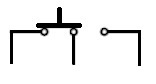
Switch Symbol
Slide Switch Construction
A slide switch is constructed using metal slides that make contact with flat metal contact pads inside the switch. When the slider is moved, these metal contacts slide from one set of terminals to another, actuating the switch.
A typical slide switch consists of three main components: terminals, sliding contacts, and an actuator handle. These parts are explained in detail below.
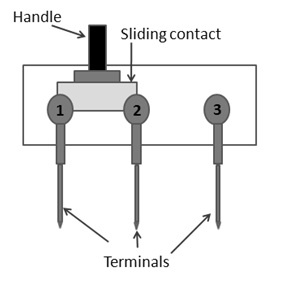
Slide Switch Construction
Terminals
A slide switch typically features three terminals: one common pin and two additional pins that alternately connect to the common pin. These are ideal for selecting between two power sources or switching between different input signals.
Sliding Contact
The sliding contact is the conductive element through which electric current passes. It generally consists of a stationary contact (similar to a brush) and a moving contact surface. The materials used for these contacts must ensure stable, low contact resistance and high wear resistance.
Handle
Slide switches are equipped with a lever or slider handle, which is manually moved from one position to another to change the switch’s operating state.
How Does a Slide Switch Work?
Slide switches operate by moving a slider actuator between the OFF and ON positions, controlling the flow of current in a circuit, commonly used in small electronic devices. They are mainly built using two internal mechanisms: the sliding contact type and the seesaw contact type.
The most common design uses a metal sliding contact that engages with flat conductive contacts inside the switch. As the external slider is moved, the internal contact shifts from one set of terminals to another, activating or deactivating the circuit.
The second design uses a metal seesaw mechanism. The slider includes a spring that presses down on one side of the seesaw or the other. These are maintained-action (latching) switches, meaning they stay in their current position until manually moved to a new state, after which they remain there until adjusted again.
Slide Switch Specifications
Slide switch specifications vary by manufacturer, but typical electrical and mechanical ratings include the following:
- Voltage rating: Up to 24 VDC max
- Current rating: Up to 500 mA max
- Contact rating: 12 VDC, 200 mA
- Actuator style: Flat or raised
- Pin pitch: 2.54 mm or 5.08 mm
- Environmental protection: Dust and moisture resistant
- Contact resistance: Below 50 mΩ
- Insulation resistance: Above 100 MΩ at 500 VDC
- Dielectric strength: 500 VAC, 50 Hz for 1 minute
- Operating temperature range: -10 °C to +60 °C
- Mechanical life: Minimum 5,000 cycles
- Contact material: Silver-plated phosphor bronze
- Terminal material: Silver-plated brass
- Contact type: Non-shorting
Types of Slide Switches
A variety of slide switches are available to suit different application requirements. Below are the most common types.
SPDT Slide Switch
Also referred to as a three-way switch, an SPDT (Single-Pole Double-Throw) slide switch connects or disconnects one conductor to either of two separate conductors.
This type of switch typically has three terminals and is often used in switching and selection circuits.
If you want, I can continue polishing the Applications, Advantages, Disadvantages sections into full professional English for your product docs.
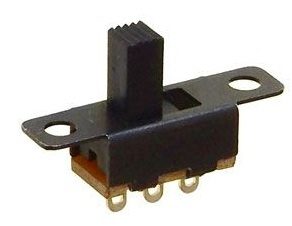
SPDT Slide Switch
Miniature Slide Switch (Standard ON/OFF Type)
This is a basic slide switch used for simple ON/OFF control and general switching functions. It has a pin spacing of 0.1 inches, but its slim profile means it is not recommended for breadboard use.
These switches are rated at 0.3 A at 50 VDC. Due to their extremely compact size, they occupy very little space on printed circuit boards (PCBs).
SPST Slide Switch
SPST (Single-Pole Single-Throw) slide switches feature two terminals. One terminal connects to one side of the circuit, while the other connects to the opposite side.
When the slider is not actuated, it remains in the OFF position, keeping the circuit open. When the slider is moved toward the terminal, the switch turns ON, closing the circuit and establishing a connection between the two sides.
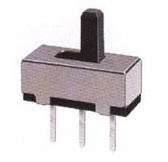
SPST Slide Switch
DPST Slide Switch
DPST (Double-Pole Single-Throw) slide switches are primarily used to connect or disconnect two separate circuit conductors within a single branch circuit. Typically, these switches feature four terminals. The contacts are mechanically separated by a spring but electrically linked via a center pin—this center pin can be removed to convert the switch into a momentary type.
When the slider is moved to one side (either up or down), the center pin bridges one pole to the other, allowing electric current to flow between them. Conversely, when the slider is moved to the opposite side, this connection is broken, and no current passes through the switch.
DPST slide switches are available in several design variations. For instance, some models include indicator lights to display the selected position; others may have more than two poles on each side of the switch, or multiple throws per pole. To learn more about how a DPST switch operates, click here.
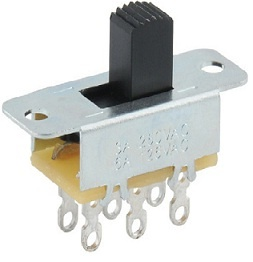
DPST Slide Switch
DPDT Slide Switch
DPDT (Double-Pole Double-Throw) slide switches are used to connect or disconnect two conductors across two separate circuits. Typically, these switches feature six terminals. Two of these terminals are internally connected within the switch, meaning they are effectively linked together as one.
The remaining four terminals are connected to external electrical circuits and devices in a variety of configurations. When voltage is applied to one pair of terminals and ground to another pair, the circuit will conduct electricity in only one direction.
If voltage is applied to both pairs of terminals simultaneously, the circuit will conduct electricity in both directions at once — a scenario known as a short circuit.
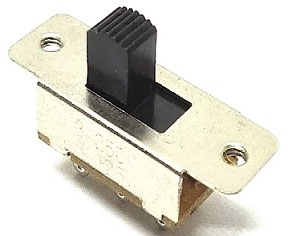
DPDT Slide Switch
Slide Switch Vs Paddle Switch
The key differences between a slide switch and a paddle switch are outlined below:
Slide Switch
- Controls an electrical circuit by using a sliding action to shift the switch from the OFF position to the ON position.
- Normally referred to as SPDT (Single-Pole Double-Throw) switches.
- Constructed with ultra-lightweight epoxy material mixed with glass.
- Voltage rating: Up to 24 VDC.
- Current rating: Up to 500 mA.
- Operating temperature range: -30°C to +85°C.
Paddle Switch
- Used for detecting litter material or dust levels within hoppers, silos, and similar equipment.
- Also known as level switches.
- Made of metal and plastic.
- Maximum switching voltage: 230 VAC.
- Maximum carry current: 3 Amps.
- Maximum operating temperature: 200 degrees Celsius.
Slide Switch Interfacing with Arduino Uno R3
The interfacing of a slide switch with an Arduino Uno R3 (used to activate or deactivate an external LED) is shown below. As noted earlier, a slide switch controls circuit connection or disconnection via the sliding motion of its handle.
The components required to build this circuit include: a slide switch, Arduino Uno R3, USB cable, 220Ω resistor, LED, breadboard, and jumper wires.
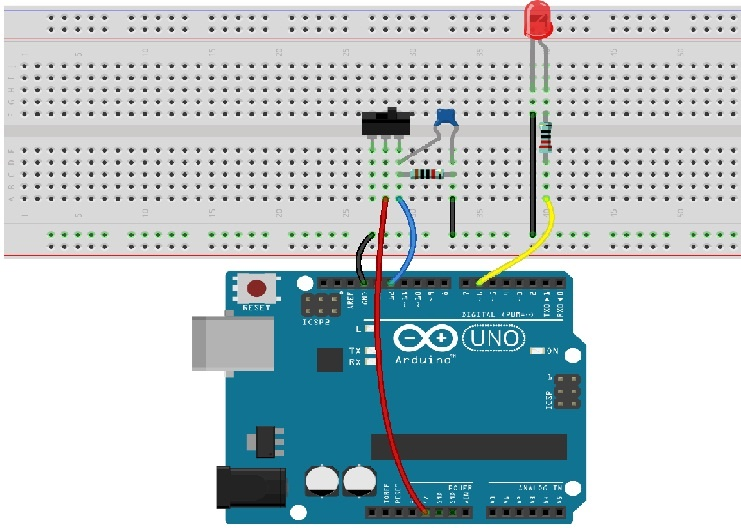
Slide Switch Interfacing with Arduino Uno R3
Generally, these switches are used with low voltage in a circuit, and their key features are stability and flexibility. This switch has three pins, with the center pin being fixed. When the handle is moved to the left, the two left-side pins connect. Similarly, when the handle is pushed to the right, the two right-side pins connect to switch the circuit.
In this setup, the slide switch plays a key role in controlling the LED. The circuit can be connected as follows: Connect the center pin of the switch to the Arduino’s VCC. Then, connect a 10K resistor and a 104 capacitor to the last pin of the switch, followed by connecting this end to GND. Connect an LED (light-emitting diode) to pin 6 of the Arduino.
When the slide switch handle is pushed toward the pin connected to pin 12, the pin reads a HIGH level. Thus, we can light up the LED at pin 6 using the following programming:
// Controlling LED with a slide switch
// Turns on and off an LED when sliding the switch
const int switchPin = 12; // The switch is connected to pin 12
const int ledPin = 6;     // The LED is connected to pin 6
int switchState = 0;      // Variable for reading the switch status

void setup()
{
  pinMode(switchPin, INPUT);  // Initialize switchPin as input
  pinMode(ledPin, OUTPUT);    // Initialize ledPin as output
}

void loop()
{
  // Read the state of the switch
  switchState = digitalRead(switchPin);

  if (switchState == HIGH)  // If the switch state is HIGH
  {
    digitalWrite(ledPin, HIGH);  // Turn the LED on
  }
  else
  {
    digitalWrite(ledPin, LOW);   // Turn the LED off
  }
}
Advantages and Disadvantages of Slide Switches
Advantages
- They are widely used mechanical switches due to their simple and intuitive functionality.
- They offer a visual advantage, allowing operators to easily identify the switch’s current operating state (ON/OFF or selected position).
- They are available in both standard and compact sizes, making them suitable for various applications with different space constraints.
Disadvantages
- Frequent sliding of the actuator can cause it to wear down over time, leading to reduced precision and potential failure.
- The internal mechanical components are subject to fatigue and wear with prolonged use, which may shorten the switch’s lifespan.
- They may experience interference or issues in applications involving signal or traffic broadcasting.
- They are relatively vulnerable to damage from external factors such as physical impact, dust, or moisture (unless specifically rated for protection).
Applications of Slide Switches
Slide switches are versatile and find applications across consumer, industrial, and electronic sectors, including:
- Small-scale electronic projects and prototypes.
- Connecting two additional circuits to an existing one, enabling optional switching between them.
- Any application requiring switching between two or more fixed positions.
- Extensive use in consumer and industrial equipment, such as computer peripherals, consumer electronics, household appliances, test equipment, smart home systems, and communication hardware.
- Network devices, including routers, personal computers (PCs), and monitors.
- Telecommunication devices, such as modems, telephones, transmitters, and receivers.
- Consumer products, including thermostats, headphones, smartphones, remote controls, and television sets.
- Test and data acquisition equipment, as well as power tools like sanders, drills, grinders, routers, and jigsaws.
Conclusion
In summary, this article provides a comprehensive overview of slide switches, including their construction, working principle, types, comparisons, interfacing with Arduino, advantages, disadvantages, and applications. Slide switches are primarily used to control the flow of electric current in a circuit by means of a mechanical sliding actuator to switch between ON and OFF states. They are particularly well-suited for small circuits and are often used as the main power switch in battery-operated devices.
Here is a question for you: What is a toggle switch?
Related Articles
Diode Dynamics: Real-World Behavior in Fast Power and RF Circuits

Christopher Anderson
Christopher Anderson has a Ph.D. in electrical engineering, focusing on power electronics. He’s been a Senior member of the IEEE Power Electronics Society since 2021. Right now, he works with the KPR Institute of Engineering and Technology in the U.S. He also writes detailed, top-notch articles about power electronics for business-to-business electronics platforms.
Subscribe to JMBom Electronics !