

 All Products


What is a Temperature Switch?
 Feb 10, 2026
 437
437Catalog
Working PrincipleSpecificationsTemperature Switch TypesTemperature Switch Circuit DiagramTemperature Switch Vs ThermostatTemperature Switch HS CodeApplicationsFrequently Asked Questions (FAQs) About Temperature SwitchRelated ArticlesSwitches are essential components in nearly all electrical and electronic systems, used to manage device operation. As key elements within control systems, they enable reliable control functions across a wide range of applications.
In industrial settings, various switch types serve distinct purposes—including toggle, slide, push-button, rotary, liquid-level, temperature, and pressure switches, among others. Of these, temperature switches are among the most widely used in industry for monitoring and regulating the temperature of diverse machinery and equipment.
This article explores the temperature switch: how it works, its different types, and common real-world applications.
What is a Temperature Switch?
A temperature switch is a mechanical device used to monitor and control temperature in manufacturing and industrial processes. It activates or deactivates its switch contacts once a preset temperature threshold is reached. Compact and cost-effective, it provides reliable temperature measurement for movable and space‑limited applications. The symbol for a temperature switch is shown below.
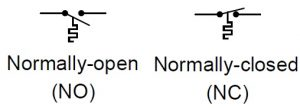
Temperature Switch Symbols
The operating state of these switches changes primarily in response to input temperature, making them ideal for overheat protection.
They are mainly used to monitor the temperature of equipment and machinery.
Temperature Switch Construction
Key components of a temperature switch include the switch housing, range nut, range spring, main spindle, bellows, capillary tube, and temperature sensing bulb.
The construction diagram for the temperature switch is shown below.
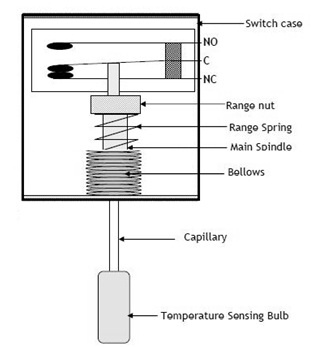
Construction
As shown in the diagram above, the fluid inside the temperature sensing bulb reacts to changes in temperature.
As temperature rises, pressure inside the bellows increases. This increased pressure compresses the bellows and drives the spindle upward until the forces from the spring and the bellows pressure reach equilibrium.
This spindle movement actuates the switch, turning it on or off according to the preset switch set point.
Working Principle
The operation of a temperature switch relies on temperature changes within an enclosed system.
Temperature switches are designed to actuate when temperature variations occur.
When the sensing probe detects a rise in temperature, it opens the electrical contacts.
Conversely, when a temperature drop is detected, the contacts close.
These temperature fluctuations activate the switching mechanism.
Specifications
Typical specifications for temperature switches include:
- Supply voltage: 12–30 VDC
- Accuracy: ±0.1% FS, ±0.3% FS, ±0.5% FS
- Pressure resistance: Typically 40 bar minimum to 300 bar maximum
- Long-term stability (1 year): ±0.1% FS
- Response time: 5.4 s at 90 °C (T90); 2.3 s at 50 °C (T90)
Temperature Switch Types
Temperature switches are classified into two main categories: mechanical temperature switches and electronic temperature switches.
Mechanical Temperature Switches
Mechanical temperature switches are available in two primary types: bimetallic temperature switches and liquid expansion temperature switches. Both are used to measure or detect changes in temperature in industrial and manufacturing applications.
Bimetallic Temperature Switch
A bimetallic temperature switch (also referred to as a bimetallic thermometer switch) utilizes a bimetallic strip, which converts temperature changes into mechanical displacement. The core principle behind the bimetallic strip is the differential thermal expansion of metals—when temperature changes, the volume (and length) of the metals in the strip changes at different rates.
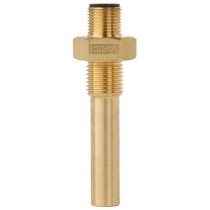
Every metal has a unique temperature coefficient, which defines the relationship between the change in the metal’s physical dimensions and the temperature causing that change. Specifically, the expansion or contraction of a metal depends primarily on its temperature coefficient; this means that different metals will undergo varying physical dimensional changes even when exposed to the same temperature.
The key advantages of bimetallic temperature switches include their compact size and low cost. However, they also have several disadvantages: lower accuracy, susceptibility to vibrations and shocks, inability to handle high temperatures, and performance degradation when ambient temperatures fluctuate.
Liquid Expansion Temperature Switch
A liquid-filled temperature switch (or liquid expansion thermometer switch) consists of a brass bulb filled with a gas or chemical fluid, forming a fluid-filled bulb system. The thermometer bulb contains a large volume of this fluid, which is highly sensitive to temperature changes. When the bulb is heated, the enclosed fluid expands, increasing the fluid pressure inside the bulb. This rise in fluid pressure triggers the activation of a pressure switch connected to the bulb.
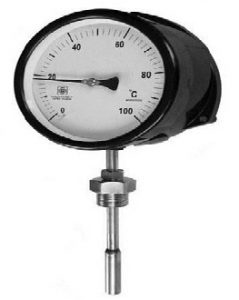
Liquid Expansion Thermometer
The advantages of a liquid expansion temperature switch include low cost, compact size, and higher accuracy. However, it has several disadvantages: slow response time, potential fluid leakage, and limited resistance to high temperatures and shocks.
Electronic Temperature Switch
An electronic temperature switch primarily comprises a power supply, a measuring element, and an electronic circuit. It measures temperature by converting temperature changes of the measuring element into a switching signal. This switching signal varies in proportion to the temperature and can be calculated accordingly. Electronic temperature switches are ideal for applications where high accuracy is required.
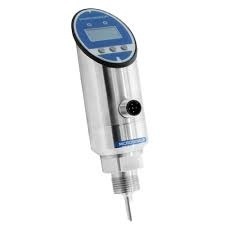
Electronic Temperature Switch
Temperature Switch Circuit Diagram
The temperature switch circuit diagram is shown below. The main function of this circuit is to control a cooling fan. Generally, these switches are designed to provide automatic control for temperature-regulating equipment.
The circuit is connected as shown in the diagram above; this diagram illustrates a 2-wire temperature switch used to control a cooling fan motor. The circuit operates as follows: when high temperature causes the switch to close, it immediately activates coil "F". This coil then closes the two "F" contacts to start the motor.
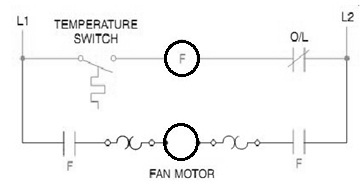
Temperature Switch for Controlling Cooling Fan
The circuit is connected as per the above-shown diagram; So this diagram illustrates a 2-wire temperature switch for controlling a cooling fan motor. The working of this circuit is, that when a high temperature shuts the switch, then it immediately activated ‘F”. This coil closes two ‘F’ contacts for activating the motor.
Temperature Switch Vs Thermostat
The difference between a temperature switch and a thermostat includes the following.
Temperature Switch
Thermostat
The temperature switch is also known as a thermal switch. The thermostat is also known as an indicator or thermometer.
The main function of this switch is to measure temperature. A thermostat device’s function is to regulate temperature,
This switch is a bi-stable electromechanical device. This is a closed-loop control device.
Generally, these switches are classified into two types electronic and mechanical. Thermostats are classified into three types programmable, non-programmable and smart.
This switch includes two main parts like sensing part and snap-action contacts. The thermostat includes different parts like flange, frame, housing, and wax element.
Temperature Switch HS Code
HS code (Harmonized Commodity Description and Coding System) is a set of numbers (at least 6 digits) used by customs authorities to classify shipped products. This classification allows customs to accurately calculate taxes and duties, as well as apply any necessary restrictions. Omitting the HS code from a commercial invoice will result in shipment delays. As a global standard for describing commodities, every product crossing international borders must be identified by customs using an HS code.
Below is a table showing import shipment data for temperature switches with their corresponding HSN codes (note: HSN codes are the Indian adaptation of HS codes, used for domestic and import classification in India):
| HS Code | Product | Source | Destination |
|---|---|---|---|
| 90328990 | The opener of Temperature Switch 150 C – 125961 – | Germany | India |
| 90328990 | Intelligent, Programmable – TTR31- Thermophant TTTR31-Temperature Switch -, A1C12WAE1XYB P.O.1023282298 S.O.3016344852 | Germany | India |
| 90328990 | Temperature Switch – TS-SNA/SNK-PT100 – 1920000266 | Germany | India |
| 90328990 | ETS or Electronic Temperature Switch 7246-A-137 | Germany | India |
| 90321090 | Temperature Limit Switch (TLS) 200 C Injection Moulding Machinery Parts | Germany | India Note: HS code 90328990 falls under Chapter 90 of the Harmonized System, which covers optical, photographic, cinematographic, measuring, checking, medical or surgical instruments and apparatus, precision instruments and apparatus; parts and accessories thereof. This code is commonly used for temperature switches that do not fall under specific subheadings within Chapter 90. |
Applications
Temperature switches have a wide range of applications across various industries and settings, including the following:
- They are primarily designed for use in heating systems, boilers, circulation pumps, air heaters, burners, and similar temperature-regulating equipment (including those used in residential and industrial heating setups referenced in customs guidance).
- They are widely used in diverse industries such as pharmaceuticals, automotive engineering, and foodstuffs, where precise temperature monitoring and control are critical.
- They can be integrated with pumps, boilers, and heating systems to ensure safe and efficient operation by preventing overheating.
- Thermal switches (a type of temperature switch) are commonly used in kitchens and restaurants to monitor the temperature of cooked food, ensuring food safety and quality.
- These switches play a key role in information processing equipment and industrial machinery, providing overheat protection to prevent equipment damage and ensure operational safety.
- They are also used in electronic devices such as RF power amplifiers, motor drives, and power supplies, where temperature control is essential for reliable performance (complementing their diverse classification by type and application).
Frequently Asked Questions (FAQs) About Temperature Switch
What is the Purpose of Temperature Switch?
The main purpose of the temperature switch is to monitor the temperature of machinery & equipment. These are used to limit temperature in industries and protect machinery from overheating.
What is the Deadband of Temperature Switch?
The deadband of the temperature switch is the difference within temperature between the increased set point & decreased set point.
Are Temperature Switches Normally Open or Closed?
When the temperature switch is Normally Open (NO), then the switch contacts are NO normally open at minimum temperature. Similarly, Normally Closed (NC) means that the switch contacts are NC at minimal temperature.
This switch gets activated by a change in temperature & changes its condition from NO to close or from NC to open. The NO thermal switch contacts usually stay open which will close with the increase in temperature.
What is Temperature Differential on Thermostat?
The temperature differential on the thermostat is the setting at which point the thermostat activates once the room temperature drops under the set temperature.
Thus, this is brief information on temperature switch – types, working with applications. This is a bi-stable electromechanical device used to activate or deactivate a minimum of one or above electrical switching elements at a set point on increasing or decreasing temperature. Here is a question for you, what is a temperature sensor?
Related Articles
Diode Dynamics: Real-World Behavior in Fast Power and RF Circuits

Christopher Anderson
Christopher Anderson has a Ph.D. in electrical engineering, focusing on power electronics. He’s been a Senior member of the IEEE Power Electronics Society since 2021. Right now, he works with the KPR Institute of Engineering and Technology in the U.S. He also writes detailed, top-notch articles about power electronics for business-to-business electronics platforms.
Subscribe to JMBom Electronics !